
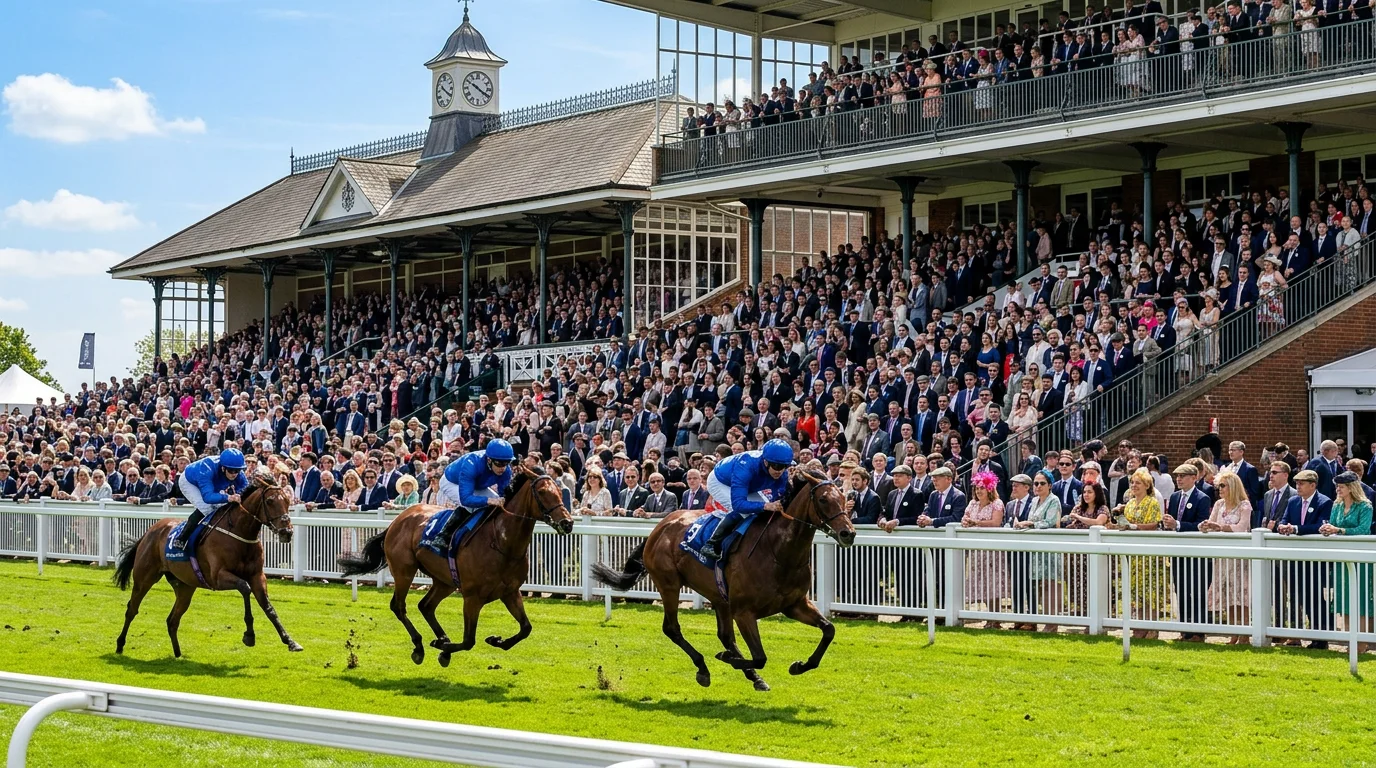
Racing Every Day of the Year
The UK is the only country in the world where horse racing takes place virtually every day of the year. Across 59 licensed racecourses, the British Horseracing Authority scheduled over 1,400 fixture days in 2025, split between two parallel disciplines, Flat and National Hunt, that run overlapping seasons and produce a continuous calendar of betting opportunities from New Year’s Day to New Year’s Eve. No off-season, no dead months, no gap longer than a few days at most. A year in the saddle, literally.
The scale of the operation is substantial. Total attendance at UK racecourses reached 5.031 million in 2025, exceeding 5 million for the first time since 2019, according to the BHA’s 2025 Racing Report. Prize money across the year rose to £153 million, an increase of £4.7 million on 2024, as documented in the BHA’s Q3 2025 Racing Report. Those figures reflect a sport that is not merely surviving in the streaming age but actively growing its in-person and financial footprint.
For bettors, the UK horse racing calendar 2026 is not just a schedule. It is a strategic map. The biggest festivals attract the deepest markets, the most competitive promotional offers, and the most liquid exchange pools. The quieter periods between festivals offer different advantages: smaller fields, more predictable form, and bookmakers less focused on headline promotions but still competing on odds. Understanding the rhythm of the year, knowing when the big meetings fall and what each one offers, is the foundation of any structured approach to racing betting.
This guide covers the full calendar: the distinction between Flat and National Hunt, the three flagship festivals that dominate the spring and summer, the major meetings that fill the rest of the year, and a seasonal strategy framework for allocating your betting activity across the twelve months.
Flat vs National Hunt: Two Seasons, One Sport
British horse racing operates as two disciplines that share racecourses, governing bodies, and betting infrastructure but differ in almost every other respect. Flat racing and National Hunt (jump racing) are distinct sports with distinct seasons, distinct horse populations, and distinct betting characteristics. Understanding the differences is the starting point for navigating the calendar.
Flat Racing
Flat races are run on level ground without obstacles, over distances ranging from five furlongs (roughly 1,000 metres) to two miles and six furlongs. The emphasis is on speed. Horses are typically younger, often two or three years old for the Classic races, and their careers are shorter but more commercially valuable due to breeding potential. The Flat season on turf runs from April to October, with the highest-profile fixtures concentrated between May and September. All-weather flat racing on synthetic surfaces runs year-round at venues like Kempton, Lingfield, Wolverhampton, and Newcastle, providing a continuous betting product through the winter months.
From a betting perspective, Flat racing tends to produce more formful results. Smaller fields, clearer class distinctions, and the absence of jumping hazards reduce the randomness compared to National Hunt. Win singles and forecasts are popular bet types on the Flat, where strong form analysis can identify value with reasonable consistency.
National Hunt Racing
National Hunt races involve either hurdles (smaller obstacles, typically eight to twelve per race) or steeplechase fences (larger, more demanding obstacles including ditches and water jumps). Distances are longer, typically two to four miles, and the emphasis shifts from pure speed to stamina, jumping ability, and courage. Horses tend to be older, typically five to twelve years, and the attrition rate is higher due to the physical demands of jumping at speed.
The jump season runs from October to April, peaking with the Cheltenham Festival in March and the Grand National meeting in April. Winter jumping is the heartland of British racing culture, with a loyal following and a betting market that skews toward each-way bets, accumulators, and ante-post wagers on the spring festivals.
Jump racing produces more upsets than Flat racing. Falls, unseated riders, and the gruelling nature of long-distance chases introduce variables that form analysis alone cannot fully account for. This volatility is part of the appeal for bettors: the payouts can be larger, the each-way value richer, and the ante-post markets more dynamic as the season develops.
The Overlap
| Feature | Flat Racing | National Hunt |
|---|---|---|
| Season (turf) | April – October | October – April |
| All-weather | Year-round | N/A |
| Obstacles | None | Hurdles / Fences |
| Distance range | 5f – 2m6f | 2m – 4m+ |
| Typical horse age | 2 – 5 years | 5 – 12 years |
| Key festivals | Royal Ascot, Glorious Goodwood, York Ebor | Cheltenham, Grand National, King George |
| Betting character | More formful, smaller fields | More volatile, bigger fields |
The two seasons overlap in spring and autumn, creating transition periods where both disciplines run simultaneously. March and April see the tail end of the jump season alongside the opening weeks of the Flat turf season. September and October reverse the pattern, with the final Flat Classics overlapping with the first major jump meetings. For bettors, these overlap periods offer the greatest variety of racing on any given day.
Cheltenham Festival (March)
Cheltenham is the centre of the jump racing universe. Four days in March, set against the backdrop of Cleeve Hill in Gloucestershire, with 28 races that represent the championship round of the National Hunt season. Every major trainer, every top jockey, and every serious racing bettor treats Cheltenham as the defining meeting of the year. The betting volume reflects that status. William Hill projected a total betting turnover of £450 million across the four days of the 2026 Festival, making it the single biggest betting week of the racing year.
Structure of the Festival
The Festival is structured around four days, each anchored by a championship race. Champion Day (Tuesday) features the Champion Hurdle, the two-mile hurdling championship. Ladies Day (Wednesday) is headlined by the Champion Chase, the two-mile steeplechase equivalent. St Patrick’s Thursday builds toward the Stayers’ Hurdle over three miles. Gold Cup Day (Friday) culminates in the Cheltenham Gold Cup, the most prestigious prize in jump racing, run over three miles and two furlongs of demanding fences.
Each day also includes a large-field handicap and several competitive novice races, where the next generation of stars emerges. For bettors, the variety across the card is exceptional: short-distance hurdling, long-distance chasing, large-field handicaps paying four each-way places, and novice events where ante-post value can be found months in advance.
Attendance and the 2026 Cap
Cheltenham’s total attendance in 2025 was 218,839, the lowest figure in a decade, according to Racing Post data. For context, the 2022 Festival welcomed 280,627. The decline prompted Cheltenham to introduce a daily attendance cap of 66,000 for 2026, the second consecutive reduction, designed to improve the on-course experience for those who do attend.
The BHA’s Racing Report linked the broader trend in betting behaviour to regulatory pressures, noting that the concentration of betting activity around flagship fixtures reflects a structural shift in the market. As the report stated, the preference for premium events is connected to affordability checks and the resulting reduction in higher-staking customers elsewhere on the calendar. Cheltenham absorbs a disproportionate share of the remaining big-event spending.
Betting at Cheltenham
The Cheltenham ante-post market opens months before the Festival and offers some of the most volatile and rewarding prices of the year. Horses can shorten from 25/1 to 5/1 between December and March based on trial results. Non-runner risk is the trade-off, but for punters willing to accept that risk, ante-post Cheltenham betting has historically delivered superior value to day-of-race prices.
On race days, Best Odds Guaranteed is offered by most major bookmakers across the Cheltenham card. Enhanced each-way terms (extra places on selected handicaps) are standard promotional fare during the Festival. Bookmaker streams, ITV coverage, and exchange markets all peak in volume and liquidity during Cheltenham week, creating the most competitive betting environment of the year.
Grand National (April)
The Grand National is the most famous horse race in the world and the single biggest betting event on the British calendar. Held at Aintree Racecourse in Liverpool each April, it draws a television audience of over 5.2 million viewers on ITV, according to ITV Press Centre data, and attracts millions of once-a-year punters who otherwise never place a bet on horse racing. If Cheltenham is the purist’s championship, the Grand National is the sport’s shop window.
The Race Itself
The Grand National is run over approximately four miles and two furlongs, with 30 fences including famous obstacles like Becher’s Brook, The Chair, and the Canal Turn. Up to 40 runners contest the race, making it the largest field in British racing and one of the most unpredictable betting events of the year. The combination of extreme distance, demanding fences, a large field, and the fitness demands of a late-season race creates a level of uncertainty that no amount of form study can fully resolve.
Aintree has introduced significant safety modifications to the fences over the past decade, softening their profiles and improving the ground management around the most challenging obstacles. The aim is to reduce falls without eliminating the unique character of the race. These modifications have gradually increased completion rates, which in turn has made form analysis slightly more reliable than in previous decades.
Betting on the Grand National
The 40-runner field and the handicap conditions make the Grand National a natural each-way race. Most bookmakers offer 1/4 odds on the first four places, with some extending to five or six places as a promotional enhancement. Non-Runner No Bet (NRNB) deals are standard on most ante-post Grand National markets, removing the risk of backing a horse that does not ultimately run.
The ante-post market for the Grand National opens as early as the previous autumn, with the most significant price movements occurring after the weights are published in February and after the final declarations in the week of the race. Horses that perform well in recognised trial races, such as the Bobbyjo Chase or the Haydock Grand National Trial, typically shorten in the market. Those that pick up unfavourable weight allocations or encounter fitness setbacks drift.
For the casual punter placing one bet a year, the Grand National offers entertainment value that no other race matches. For the serious bettor, it is a high-variance puzzle where each-way value, NRNB protection, and careful assessment of stamina and jumping ability matter more than raw speed.
Royal Ascot (June)
Royal Ascot is the jewel of the Flat season: five days of racing in June that combine the highest quality competition with a level of pageantry no other meeting attempts. The Royal Procession along the straight mile, the dress code enforced by enclosure, and the presence of the Royal Family give Ascot a cultural profile that extends well beyond the sport itself. The 2025 edition attracted 5 million television viewers across its five days on ITV, confirming its status as the Flat equivalent of Cheltenham in terms of public engagement.
The Racing Programme
Royal Ascot features 35 races across five days, including eight Group 1 contests, the highest classification in Flat racing worldwide. The Gold Cup over two and a half miles is the centrepiece, but the sprints attract the deepest betting markets. The King’s Stand Stakes (five furlongs) and the Diamond Jubilee Stakes (six furlongs) are among the most competitive races of the European season, drawing runners from across the globe.
Large-field handicaps, particularly the Royal Hunt Cup, the Wokingham Stakes, and the Buckingham Palace Stakes, provide each-way and exotic betting opportunities that mirror the big Cheltenham handicaps. These races regularly feature 20 or more runners, creating the conditions where each-way bets at longer prices offer genuine value and where forecast and tricast dividends can reach eye-catching figures.
International Dimension
Royal Ascot regularly attracts runners from Australia, the United States, Japan, Hong Kong, and across Europe. International raiders have become increasingly successful in recent years, winning Group 1 races with regularity. For bettors, this international dimension adds complexity to the form analysis. A horse trained in Australia and racing in the UK for the first time presents a different kind of assessment challenge than a domestic runner with a well-established form profile. The betting market’s initial reaction to overseas runners is often imprecise, which creates opportunities for punters willing to do the research.
Betting at Royal Ascot
The betting market at Royal Ascot is deep and liquid, particularly on the Group 1 races and the big handicaps. Best Odds Guaranteed is available across the card from most major bookmakers. Ante-post markets open months in advance, with significant price movements following key trial races at Newbury, York, and the Guineas meeting at Newmarket. Enhanced each-way terms on the handicaps are a standard promotional feature during the week. Exchange liquidity on Betfair peaks during Royal Ascot, making it one of the best weeks of the year for punters who prefer the exchange model.
Other Major Fixtures
Beyond the three flagship festivals, the UK racing calendar is dense with meetings that offer serious betting value and competitive fields. These fixtures lack the global profile of Cheltenham or Ascot but attract strong runners, healthy prize money, and betting markets worth attention.
Epsom Derby Festival (May/June)
The Derby, run over a mile and a half at Epsom Downs, is the most prestigious Classic race in British Flat racing and the centrepiece of a two-day meeting that also features the Oaks and the Coronation Cup. The undulating Epsom course is unique in British racing and tests a different set of attributes than any other track, making the Derby a famously difficult race to handicap. For bettors, the ante-post market is active from the previous autumn, with significant volatility after the 2,000 Guineas in early May.
Glorious Goodwood (July/August)
Five days of high-quality Flat racing on the Sussex Downs, featuring the Sussex Stakes (Group 1, one mile) and the Goodwood Cup (Group 1, two miles), alongside competitive handicaps that rank among the best-value each-way betting opportunities of the summer. Goodwood’s quirky, undulating course and the summer ground conditions add variables that the formbook does not always capture.
York Ebor Festival (August)
Four days at the Knavesmire featuring the Juddmonte International (Group 1, often the race of the season), the Nunthorpe Stakes (five furlongs, the fastest race in British racing), and the Ebor Handicap itself, a cavalry charge over a mile and six furlongs that draws fields of 20 or more and produces some of the largest each-way payouts of the year.
King George VI Chase at Kempton (December)
The mid-season championship of jump racing, run on Boxing Day at Kempton Park. The King George is a three-mile chase that often pits the previous season’s Gold Cup winner against emerging stars. It is the most-watched jump race outside of the spring festivals and a critical form indicator for the Cheltenham Gold Cup three months later.
QIPCO Champions Day at Ascot (October)
The finale of the Flat season, designed as a British equivalent of the Breeders’ Cup. Champions Day features the Champion Stakes, the Sprint Stakes, and the Long Distance Cup, all at Group 1 level. It is the last opportunity to bet on top-level Flat racing before the turf season closes, and the market often offers value as the season’s narrative converges into a single afternoon.
Scottish Grand National at Ayr (April)
Run a week after the Aintree Grand National, the Scottish equivalent features a smaller but still substantial field over nearly four miles. It is less profile-heavy than its English counterpart but offers excellent each-way value and is frequently won by horses at double-digit prices.
Seasonal Betting Strategy
The racing calendar is not flat. The value distribution across the year has peaks and troughs, and aligning your betting activity with those rhythms is a strategic advantage that costs nothing to implement.
Winter: Ante-Post Season
November through February is when the serious ante-post markets for Cheltenham and the Grand National take shape. Prices are at their widest, volatility is highest, and the information set is incomplete. Trial races at Sandown, Leopardstown, and Kempton reshape the market week by week. For bettors willing to accept non-runner risk, this period offers the best prices of the year on horses that will eventually run at the spring festivals. The key is selectivity: back early only when you have a strong view on a specific horse’s likely target race, and resist the temptation to fill every market with speculative each-way ante-post bets.
Spring: Festival Concentration
March and April concentrate the jump season’s climax and the opening of the Flat turf season into six weeks. Cheltenham, Aintree, the Punchestown Festival in Ireland, and the first Flat Classics create a density of betting opportunities that demands discipline. Bankroll management matters most during these weeks. It is easy to bet every race across four days of Cheltenham; it is harder, and more profitable, to identify the four or five races where your analysis gives you an edge and focus your stakes there.
Summer: Flat Quality, Daily Volume
May through August is the peak of the Flat season, with Royal Ascot, Glorious Goodwood, and York providing the headline meetings while daily cards at Newmarket, Sandown, and Haydock offer steady, formful racing. The going tends to be faster and more consistent during summer, reducing one source of randomness. For bettors who favour systematic approaches, the summer Flat season provides the largest sample of comparable races in which to test a method.
Autumn: Transitions and Value
September and October are the overlap months. The Flat season concludes with Champions Day at Ascot, while the jump season opens with early-season fixtures at Chepstow, Wetherby, and Cheltenham’s October meeting. Attention and betting volume are split, which means less market scrutiny of individual races and, occasionally, more generous prices. Autumn also brings the first indications of which horses are being aimed at the major spring targets, making it the earliest viable window for educated ante-post speculation on the next Cheltenham Festival.
The Year-Round Principle
All-weather Flat racing runs through the winter, evening racing extends the summer cards, and there is almost always a meeting somewhere in Britain on any given day. The temptation is to bet on everything. The strategy is to bet on what you know. If you are a National Hunt specialist, the winter and spring are your season. If you follow the Flat, the summer provides the deepest and most analysable racing. If you bet across both codes, the transition months in spring and autumn offer the most diverse cards. A year in the saddle rewards the punter who matches their expertise to the calendar rather than treating every fixture day as equal.