
 Available in US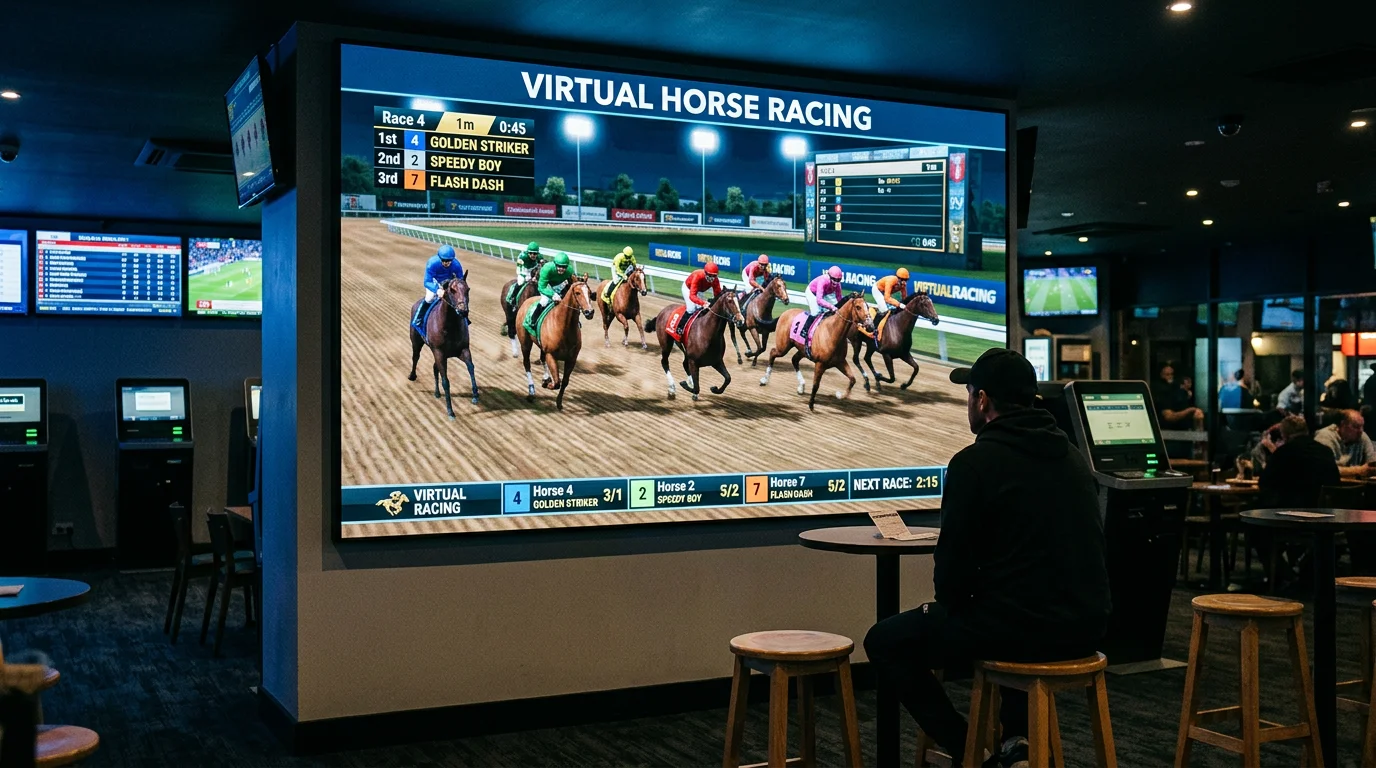
No Horses, No Form, No Going
Virtual horse racing runs around the clock on random number generators — no real horses, no jockeys, no form to study, and no going to check. The races are computer-generated simulations that produce results through a certified RNG algorithm, presented with 3D animation designed to mimic the visual experience of a real race. A new event starts every two to three minutes, twenty-four hours a day, seven days a week. It fills the gaps between real racing and provides instant betting gratification, but the dynamics are fundamentally different from anything else in horse racing. Virtual Horse Racing Betting — More on this topic at online horse betting sites.
Understanding those differences is essential before you stake real money. Virtual racing is not a substitute for the real sport — it is a separate product with its own risk profile, its own house edge, and its own implications for responsible gambling. No jockeys, no form — pure probability.
How Virtual Racing Works
Each virtual race is determined by a random number generator before the animation begins. The outcome is pre-set the moment you press play: the finishing order, the margins, and the visual presentation are all generated by the algorithm. The animation serves a purely aesthetic function — what you see on screen is a visualisation of a result that has already been decided, not a simulation of a physical contest with uncertain outcomes influenced by real-world variables.
The odds displayed before each virtual race reflect the probabilities assigned by the algorithm to each runner. These are fixed-odds markets: you take a price and the result is settled at that price, just like a real race. The key difference is that the probabilities are not derived from form, fitness, going, or any other external variable — they are set by the system’s internal mathematics, and the house edge is built into the odds structure from the outset.
The remote casino, betting, and bingo sector generates £7.8 billion in GGY annually, and virtual sports — including virtual racing — contribute a growing share to that figure. The products are supplied by specialist companies like Inspired Entertainment and Kiron Interactive, who design the algorithms, produce the animations, and licence the content to bookmakers. The bookmaker’s role is to host the product and accept bets; the outcome generation is handled entirely by the software provider.
No historical form exists for virtual runners. Each race is independent of every previous race — there are no trends, no patterns, and no data to analyse. The horse names and silks are cosmetic labels assigned by the system, and they carry no information about the likelihood of any outcome. Any perceived pattern in virtual racing results is coincidental, not predictive.
Where to Play Virtual Racing
Virtual racing is available at most major UK bookmakers, both online and in betting shops. Bet365 offers virtual horse racing through its website and app, with races running continuously and available alongside real racing markets. The presentation is clean, with odds displayed for each virtual runner and a live stream of the animated race available from the bet slip.
William Hill, Coral, Betfred, and Paddy Power all offer virtual racing products, accessible through their apps and websites. In betting shops, virtual racing terminals provide the same experience on screen — a race every few minutes with fixed-odds betting available on the displayed field. The in-shop version is identical in mechanism to the online version; the only difference is the interface.
Betfair Sportsbook includes virtual racing in its product range, though the Exchange does not — because the Exchange requires two-sided markets with genuine liquidity, and virtual racing does not support a back-and-lay model. The product is strictly a fixed-odds proposition, and no exchange equivalent exists.
The betting options on virtual racing are typically simpler than real racing. Win, place, and forecast bets are commonly available. Each-way, tricast, and exotic bet types are offered by some operators but not universally. The market range reflects the product’s positioning as a quick-fire betting alternative rather than a deep analytical exercise.
Virtual vs Real Racing: Betting Differences
The differences are fundamental, and treating virtual racing with the same analytical approach as real racing is a category error. In real horse racing, form analysis provides an empirical edge. You can study a horse’s history, assess the going, evaluate the trainer and jockey, and make a decision based on evidence. In virtual racing, none of this applies. Every race is a fresh random event with no connection to any previous result.
The house edge in virtual racing is fixed and transparent — typically built into the odds at a level comparable to or slightly higher than the overround on a real horse race. Because there is no form to exploit and no market inefficiency to identify, the house edge represents the true cost of participation over time. In real racing, a skilled punter can reduce or overcome the bookmaker’s margin through superior analysis. In virtual racing, the margin is permanent and cannot be beaten through skill.
Speed of play is the most significant practical difference. Real horse races happen at intervals of 15 to 30 minutes across meetings. Virtual races happen every two to three minutes, allowing a punter to place twenty or more bets in an hour. This dramatically compressed cycle increases the rate at which the house edge compounds — meaning losses accumulate faster than in real racing, even at the same stake per bet.
The emotional experience also differs. In real racing, anticipation builds across the card: you study the form, assess the going, make your selection, and watch the race unfold with genuine uncertainty about the outcome. In virtual racing, the cycle from selection to result is measured in seconds, and the absence of any analytical framework means each bet is identical in character to the last. There is no narrative, no storyline across a meeting, no accumulation of insight. Each race resets to zero, and the betting experience is correspondingly flatter — which for some punters increases the temptation to bet more frequently in pursuit of the engagement that real racing provides naturally.
Responsible Play with Virtual Racing
The rapid cycle time of virtual racing creates specific responsible gambling risks that punters should be aware of. The frequency of betting opportunities — one every two to three minutes — means that loss-chasing behaviour can escalate far more quickly than in real racing. A bad run on real races across a Saturday afternoon involves five or six bets over three hours. A bad run on virtual racing can involve thirty or forty bets in the same period.
The UKGC Gambling Survey for Great Britain 2024 found that 2.7% of adults scored 8 or higher on the Problem Gambling Severity Index, and the fast-cycle nature of virtual products is recognised as a contributing factor to elevated risk. Products with high event frequency and short intervals between result and next bet create conditions that are associated with problematic gambling patterns — particularly among younger users who are most comfortable with digital, fast-paced interfaces. See also History of Horse Racing Betting in Britain.
If you choose to play virtual racing, apply the same safer gambling tools you would use for any betting activity: set deposit limits, use session timers, and define a budget specifically for virtual play that is separate from your real racing bankroll. Treat virtual racing as entertainment with a defined cost, not as a strategic betting activity where skill can produce long-term profit. The maths do not support that expectation, and pretending otherwise is the fastest route to a problem. No jockeys, no form — pure probability, and a house edge that never sleeps.
