
 Available in US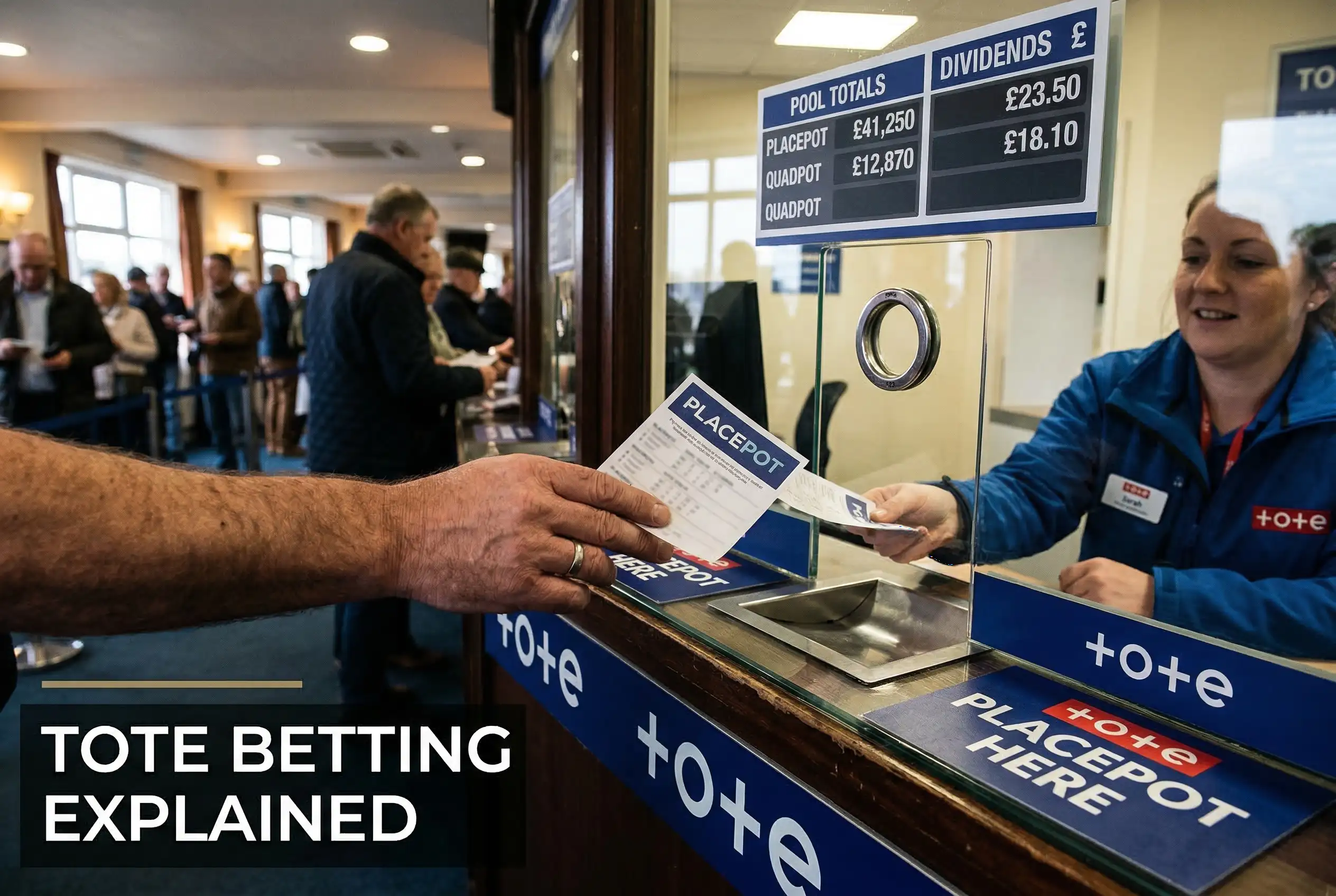
A Completely Different Betting Model
The Tote operates on a fundamentally different model from every bookmaker in Britain. When you bet with a bookmaker, you take a fixed price and the bookmaker assumes the risk. When you bet with the Tote, your money goes into a communal pool along with every other punter’s stake, and the payout is determined by how many winning tickets share that pool after the operator’s deduction. No fixed odds, no BOG, no price to take or leave — just a pool where everyone shares the prize. Tote Betting Explained — More on this topic at online horse betting sites.
For most bettors, this model is unfamiliar. But for small-stake punters chasing significant returns, the Tote’s pool bets — particularly the Placepot and the Jackpot — represent the most realistic path to a large payout from a modest investment. A £2 Placepot can return hundreds. A Jackpot can return thousands. The mathematics are different from fixed-odds betting, and so is the strategy.
How Pool Betting Works
Pool betting aggregates all stakes on a particular bet type into a single pool. The operator — in Britain, the Tote — deducts a percentage (known as the takeout or deduction) to cover operating costs, fund the Horserace Betting Levy, and generate profit. The remaining pool is divided among all winning ticket holders in proportion to their stakes.
As Alan Delmonte, Chief Executive of the HBLB, noted in the HBLB Annual Report 2024-25, the Levy yield reached nearly £109 million — the fourth successive year of increase and the highest since the 2017 reforms. The Tote contributes directly to this Levy, meaning every pool bet you place feeds back into the sport through prize money, integrity services, and racecourse investment.
The deduction rate varies by bet type. The Tote Win pool has a deduction of approximately 16%. The Place pool runs at a similar rate. Exotic bets like the Placepot and Jackpot carry deductions of approximately 26-29%, reflecting the larger payouts and operational complexity. These deduction rates are the pool-betting equivalent of the bookmaker’s margin, and they are generally higher than the bookmaker’s equivalent — which is why the Tote is not necessarily cheaper overall, but rather offers a different risk-reward structure.
The payout — called the dividend — is declared after the race once the pool has been calculated. Unlike fixed odds, you do not know what you will be paid until the result is official. If the winning horse was backed by many punters, the dividend will be low because the pool is split among many winners. If the winner was lightly backed, the dividend can significantly exceed the equivalent bookmaker price — sometimes dramatically so on long-shot winners.
Tote Bet Types
The Tote Win bet is the simplest: pick the winner. The Place bet requires your horse to finish in the first two, three, or four depending on field size — identical to bookmaker place terms. The dividends for both are declared per £1 staked and reflect the pool distribution after deductions.
The Exacta requires you to predict the first and second finishers in the correct order. The Trifecta extends this to first, second, and third in order. Both offer substantial dividends when the result is not the obvious market order, because fewer punters correctly predict the exact finishing sequence. Reverse and combination options allow you to cover multiple permutations at an increased cost but with significantly improved chances of landing the bet.
The Placepot is the most popular Tote bet and the one that generates the highest pool values at major meetings. It requires you to pick a horse to place in each of the first six races at a meeting. A minimum stake of £1 per line is the entry point, but perming multiple selections in each race increases coverage — and cost. A Placepot with two selections in each of six races costs sixty-four £1 lines, totalling £64. The dividend is declared as a return per £1 unit, and on days when the favourites are beaten in several races, returns can reach hundreds or even thousands of pounds per unit.
The Quadpot works the same way as the Placepot but covers only the last four races at a meeting, making it a simpler and cheaper entry point. The Scoop6 requires picking the winners of six designated races across a Saturday card and carries a rollover jackpot that can reach six figures when no one collects for several consecutive weeks. The Tote Jackpot pools cover selected meetings and offer large prize funds, though availability varies by meeting and day.
Placepot Strategy: The Punter’s Favourite
The Placepot rewards breadth of opinion rather than conviction on a single horse. Because you need a horse to place — not necessarily win — in each of the six races, the emphasis shifts from identifying winners to identifying horses likely to be competitive. This changes the selection criteria: form horses with strong place records, consistent performers in their class, and horses suited to the day’s conditions all become more valuable than speculative outsiders with a slim winning chance.
Perming is the key to Placepot strategy. In races where you have a strong fancy, selecting one horse keeps the cost down. In races where the outcome is open and no horse stands out, selecting two or three increases your chance of surviving that leg. The cost scales multiplicatively — one selection in four legs and three in two legs costs 1x1x1x1x3x3 = nine lines — so the challenge is balancing coverage against affordability.
Banker races, where you confidently select just one horse, should be races with a strong market leader on suitable ground with a reliable place record. Open races, where you perm multiple selections, should be competitive handicaps or races with no clear favourite. The overall approach is defensive: you are trying to survive six consecutive races, and one weak leg can eliminate you. Protecting against every leg failing is more important than maximising the potential dividend in any single race.
Placepot dividends are declared in the afternoon after the sixth race, and the display at the track and on the Tote website shows a running total after each race — how many live tickets remain and the projected dividend. This real-time information can inform whether you want to increase your Placepot investment at the meeting or back your remaining selections in the fixed-odds market as a hedge.
Tote vs Bookmaker: When Pool Pays More
The Tote pays more than the bookmaker in one consistent scenario: when a lightly backed horse wins or places. Because the pool dividend reflects how the money was distributed rather than a pre-set price, longshots that attract minimal pool backing produce outsized dividends. A horse that wins at 20/1 with a bookmaker might return a Tote Win dividend equivalent to 30/1 or 40/1 if very few punters backed it in the pool.
Conversely, the Tote almost always pays less on heavily backed favourites. When the majority of the pool is concentrated on one horse, the dividend for that horse is suppressed by the weight of money. A 2/1 bookmaker favourite might return only 1.5/1 or less on the Tote if it attracted an outsized share of pool money. Horse racing generates £766.7 million in gross gambling yield from remote betting alone, and the Tote operates as a distinct subset within that market — one where the contrarians and the longshot specialists find their natural home. See also GAMSTOP & Self-Exclusion.
The strategic implication is clear: the Tote rewards going against the crowd. If your form analysis leads you to a horse that the majority of bettors are ignoring, the Tote is likely to offer a better return than the bookmaker. If your selection is the obvious market leader, the bookmaker’s fixed price will almost certainly beat the Tote dividend. The pool where everyone shares the prize pays best when you are one of the few holding a winning ticket.
