
 Available in US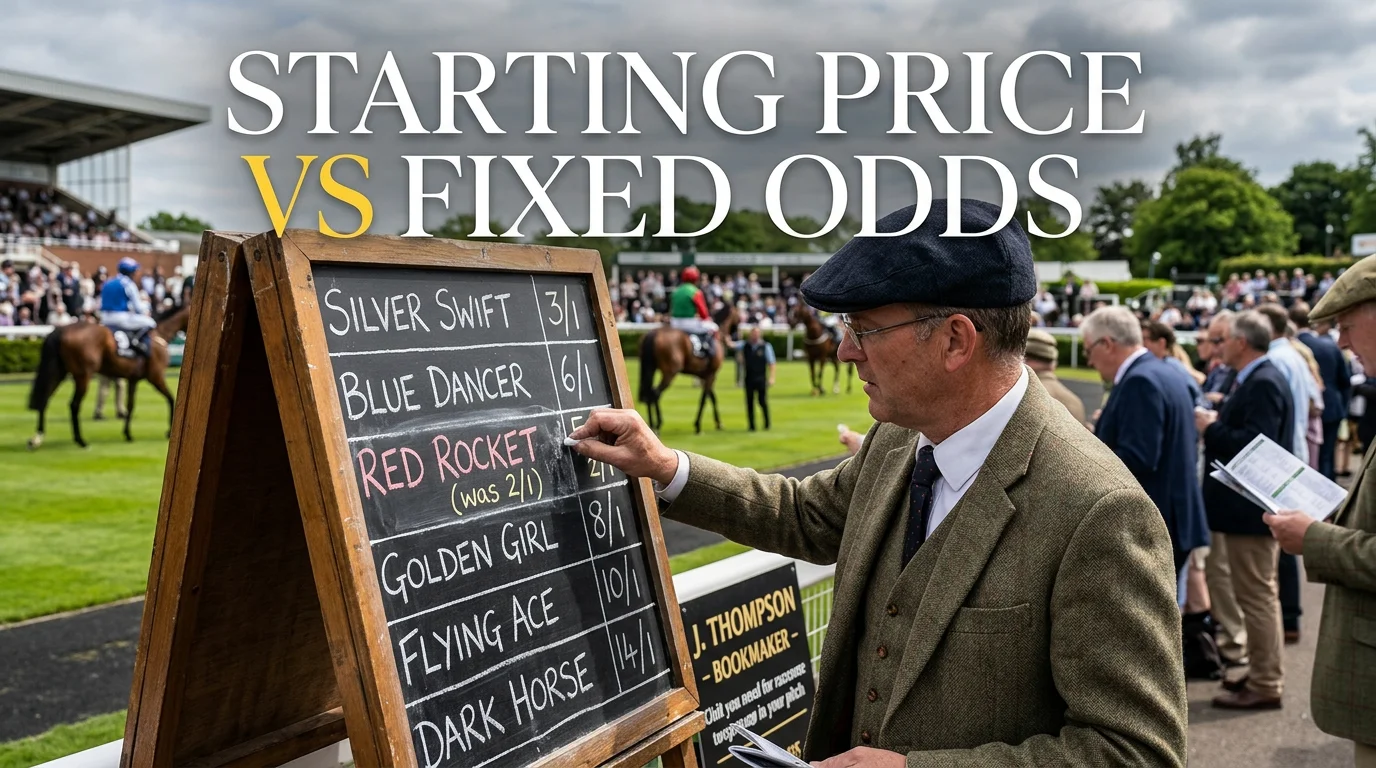
The Decision You Make Before Every Bet
“SP or price?” is the decision every horse racing punter makes before placing a bet — even if most make it without thinking. Fixed odds lock in a number the moment you click confirm: whatever happens to the market between then and the off, your payout is set. Starting Price, by contrast, hands the outcome to the market. Your bet is settled at whatever odds are returned by the official on-course calculation just before the race begins. One approach controls risk; the other embraces it. Starting Price vs Fixed Odds — More on this topic at online horse betting sites.
Neither is universally better. The right choice depends on the circumstances of each race — the information available, the likely direction of the market, and whether Best Odds Guaranteed is in play. Understanding how both mechanisms work, and when each delivers superior returns, is a fundamental skill for any punter who takes horse racing seriously. Take the price or ride the market — but make the decision deliberately, not by default.
This guide explains the SP mechanism from the ground up, maps out the advantages of taking fixed odds early, and provides a direct comparison across the scenarios where each option wins.
How Starting Price Is Determined
The Starting Price is not a bookmaker invention. It is an independently calculated figure, determined by the Starting Price Regulatory Commission (SPRC) — an independent body responsible for the integrity and accuracy of the SP. Since May 2022, the SP has been based primarily on the odds offered by a sample of major off-course bookmakers operating in Great Britain at the moment the race starts, rather than on-course prices alone. The SPRC made this change after finding that on-course betting accounted for just 1.4% of total horse racing turnover, meaning the old on-course-only method no longer represented the broader market.
The SPRC selects a sample of qualifying bookmakers who meet minimum market share thresholds and offer standard each-way terms. For each horse, the available prices from the sample are ordered from longest to shortest, split into two halves, and the SP is taken as the shortest odds in the half containing the longest prices — effectively a median calculation. This system is designed to produce a fair, independent price that reflects the genuine state of the betting market at the off.
The horse racing betting market has been under pressure in recent years. According to the HBLB Annual Report 2024-25, average betting turnover per race has declined by 19% compared to three years ago. While the move to off-course-based SP has made the calculation more representative of the overall market, reduced liquidity still affects smaller races where fewer bookmakers actively price the full field. At major meetings like Cheltenham or Royal Ascot, the market remains deep and the SP is robust. At a Monday afternoon card at a minor track, prices can be thinner and more volatile.
For punters, SP works well when you have no strong view on whether the price will shorten or drift, or when you are placing a bet close to the off and the market has already settled. It removes the need to time your bet, because you automatically receive whatever the market decides. The trade-off is that you surrender control — and in situations where you could have locked in a better price earlier, that surrender costs real money.
Fixed Odds: Locking In Your Price
Fixed odds do exactly what the name says: you take a price and it stays fixed regardless of what happens to the market afterwards. When you accept 7/1 on a horse at 10am, your bet pays 7/1 whether the SP comes in at 3/1 or 12/1. You have made a decision about value, and that decision is final.
Online bookmakers post early prices from the morning of the race — often between 8am and 10am — and these prices fluctuate continuously based on the weight of money flowing in. A popular selection attracts bets, causing the price to shorten. A horse drifting in the market (its price increasing) may reflect negative information: a poor paddock report, a jockey change, or simply a lack of punter confidence.
The appeal of fixed odds lies in certainty. If you have done your form analysis and believe a horse at 8/1 represents value, taking the price removes the risk of that value evaporating. Should the horse attract market support and shorten to 5/1 by the off, you still hold your 8/1 ticket. This is especially valuable on well-fancied runners in high-profile races where prices frequently contract as post time approaches.
Fixed odds also interact directly with Best Odds Guaranteed. Under BOG, taking an early fixed price creates a one-way bet: if the SP exceeds your price, the bookmaker upgrades you. If the SP is lower, you keep the price you took. This combination of fixed odds plus BOG is, in mathematical terms, the optimal strategy for any race where BOG is available — you capture certainty on the downside and optionality on the upside.
The risk of fixed odds without BOG is straightforward: you take 5/1 and the SP drifts to 9/1, meaning you have been paid roughly half of what the market ended up offering. This scenario stings, but it reflects the nature of the choice — fixed odds are a commitment, and like any commitment, they can look either smart or premature in hindsight.
Head-to-Head Comparison
The relationship between SP and fixed odds plays out differently depending on what the market does between the time you bet and the moment the stalls open. Three scenarios cover the range, and each produces a clear winner.
Scenario one: the odds shorten. You take a horse at 6/1 in the morning. By the off, heavy market support has driven the SP down to 3/1. If you bet at SP, you receive 3/1 — a £40 return on a £10 stake. If you took the fixed 6/1, your return is £70. Fixed odds win decisively. This scenario is common with well-backed runners, particularly in feature races where late money from informed connections floods the market in the final minutes.
Scenario two: the odds drift. You take 4/1 in the morning. The horse is friendless in the market and the SP comes in at 8/1. Without BOG, your fixed-odds bet still pays 4/1 — a £50 return — while an SP bet would have returned £90. SP wins. But with BOG active, the bookmaker upgrades your fixed-odds bet to the SP of 8/1, giving you the full £90. Under BOG, fixed odds win or draw in every scenario.
Scenario three: the price holds steady. You take 5/1 and the SP returns 5/1. Both approaches pay the same. Neither wins. This is the least interesting outcome but probably the most common in routine races where the market is efficient and information is fully priced in before the off.
The cumulative picture across a full season favours fixed odds with BOG. In a market generating £766.7 million in racing GGY, prices shorten more often than they drift on well-fancied runners — the market is generally efficient at identifying likely winners. Taking early prices on these horses captures value that disappears by race time, and BOG insures against the downside. For punters who consistently bet on horses they expect to be popular, fixed odds are the mathematically superior default.
When to Take SP, When to Take a Price
The decision framework is simpler than it appears once you consider the information available and the likely market trajectory.
Take a fixed price when BOG is available — always. This is the single most straightforward rule in horse racing betting strategy. With BOG, you can only benefit from taking the price early: you lock in current value and retain free upside if the SP improves. There is no rational argument for choosing SP over fixed odds when BOG is active.
Take a fixed price when you believe the horse will attract market support. If your form analysis identifies a strong contender that is not yet the market favourite, the early price often represents the best available number. News travels fast in racing — stable confidence, favourable going changes, jockey bookings — and prices adjust within minutes. Taking your position early, before the market digests the same information, is where price advantage lives.
Take SP when you have no view on market direction and BOG is not available. In routine mid-week races where you are betting casually and have no strong opinion on whether the price will move, SP removes the timing decision entirely. You get what the market gives. The outcome may be better or worse than an early price, but it reflects the final collective judgement of the on-course market, which is a reasonable proxy for fair value.
Take SP when the ante-post or overnight price looks artificially short. Occasionally, a horse opens at a short price in early markets that lengthens as the day progresses — perhaps the trainer enters another horse, or the going changes unfavourably. If you suspect the early price does not represent genuine value, waiting for the SP gives the market time to correct. See also Best Horse Racing Betting Apps UK 2026.
The overall principle is one of information and control. Fixed odds give you control over your payout; SP delegates that control to the market. When you have an informational edge — either through form analysis, knowledge of likely market moves, or the protection of BOG — take the price and ride the market from a position of strength. When you do not, SP is a reasonable neutral choice that removes the timing variable from the equation.
