
 Available in US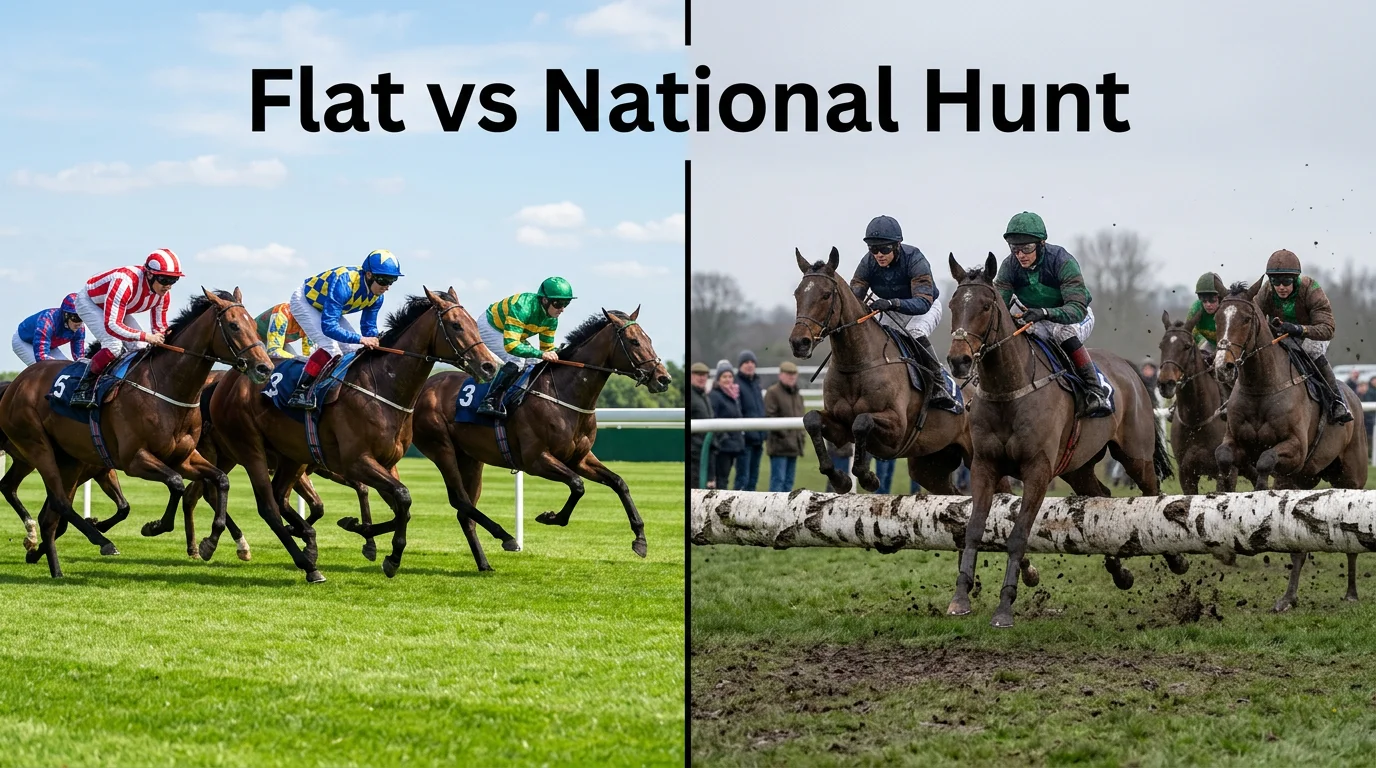
Two Codes, Two Worlds
Britain is unique in running both flat racing and National Hunt year-round, yet most bettors specialise in one code and largely ignore the other. The flat punter who lives by speed figures and draw analysis through the summer often goes quiet when the jumps season takes centre stage in winter. The National Hunt enthusiast who studies chasing form and going ground from November to April may barely glance at a racecard once the Classics arrive. Flat Racing vs National Hunt — More on this topic at online horse betting sites.
This specialisation is understandable — the two codes demand different analytical skills, different bet types, and different approaches to bankroll management. But with 5.031 million total racecourse attendees across both codes in 2025 and racing available every day of the year, understanding the differences opens up twelve months of betting opportunities rather than six. Speed on the flat, grit over fences — and a punter who can navigate both has twice the battlefield.
The Key Differences
The most visible distinction is obstacles. Flat racing involves no jumps: horses gallop on level turf (or all-weather surfaces) over distances ranging from five furlongs to two and a half miles. National Hunt racing features hurdles (smaller, brush-topped obstacles that horses jump at speed) and fences (larger, stiffer structures requiring a horse to leave the ground and clear a solid obstacle). Steeplechases feature fences; hurdle races feature hurdles. NH Flat races, known as bumpers, involve no obstacles but are run under National Hunt rules and serve as an introduction to the jumps code for young horses.
Distance ranges differ substantially. The shortest flat races are five-furlong sprints lasting barely sixty seconds. The longest — the Queen Alexandra Stakes at Ascot — covers two miles and six furlongs. In National Hunt, the minimum hurdle distance is two miles, and the longest races extend to four miles and beyond (the Grand National). This distance expansion changes the physical demands: flat racing rewards pure speed and acceleration; National Hunt racing rewards stamina, jumping technique, and the ability to maintain effort over extended periods.
Horse age and breed also diverge. Flat racing features horses from two years old upward, with the Classic races restricted to three-year-olds. Speed-bred flat horses typically descend from fast sire lines. National Hunt horses tend to be older — chasers rarely begin competitive fencing careers before age five — and are bred for stamina and size, often from Irish bloodlines with a mix of flat speed and jumping ability. With 21,728 horses in training across Britain, the population spans both codes, though many trainers specialise in one or the other.
The going affects both codes but in different ways. Flat racing on firm ground produces the fastest times and favours sharp, athletic horses. National Hunt racing on soft or heavy ground becomes an endurance contest where jumping accuracy and physical resilience are more important than raw speed. All-weather flat racing runs year-round on synthetic surfaces, providing consistency that neither turf flat nor National Hunt can offer.
When Each Season Runs
The turf flat season runs from April to October, with the major festivals concentrated in June (Royal Ascot), July (Glorious Goodwood), August (York Ebor), and October (Champions Day at Ascot). All-weather flat racing operates year-round, filling the winter months when turf flat is dormant and providing opportunities at tracks like Kempton, Lingfield, Wolverhampton, and Newcastle.
The National Hunt core season runs from October to April, with the marquee events in March (Cheltenham Festival) and April (Grand National at Aintree). The season opens with the autumn meetings at Cheltenham and Aintree, builds through the King George VI Chase at Kempton on Boxing Day, and climaxes at the Festival. Summer jumping exists but at a lower level — the quality of horses and prize money drops significantly, and many top jumps trainers give their best horses a summer break.
The overlap months of April, May, September, and October offer both codes simultaneously. April is particularly rich: the Grand National runs in the first week while the flat turf season is opening, giving punters access to the highest quality of both codes within the same fortnight. These overlap periods are when versatile punters — those comfortable with both flat form analysis and jumps assessment — have the widest range of betting opportunities.
Betting Implications
National Hunt racing produces more fallers, unseated riders, and pulled-up horses than flat racing, because obstacles introduce a variable that does not exist on the level. This increases each-way value: in a twelve-runner hurdle race, the actual number of horses that complete the course and are placed may be only eight or nine. The each-way punter benefits from the attrition — their selection’s chance of finishing in the first three is higher than the raw field size implies.
As the BHA Racing Report has noted, the preference for high-profile fixtures is linked to the impact of affordability checks, which have reduced the number of larger-staking customers. This trend affects both codes, but its betting implications differ. On the flat, where form is more predictable and fields in higher-class races are smaller, the market tends to be sharper and value harder to find. In National Hunt, where the jumping variable introduces more randomness, the market is slightly less efficient — creating more opportunities for punters who can assess jumping ability and stamina independently of the odds.
Form reliability differs between the codes. Flat form — particularly speed figures — is more predictive because the variables are fewer: no fences to fall at, narrower distance ranges, and more consistent ground conditions on all-weather. National Hunt form is noisier: a horse that fell three out when travelling well is not the same as one that was pulled up tailing off, but both show the same negative form figure. Reading the context behind jumps form — through race replays and commentary notes — is essential in a way that flat form analysis can often bypass.
Dual-Purpose Horses and Crossover Punts
Some horses compete in both codes, and spotting them at the transition point can be profitable. A flat horse switching to hurdles brings speed that most National Hunt horses lack, and if it also jumps adequately, it can dominate at the lower levels of the jumps code. The transition typically happens when a horse lacks the class to compete in the highest flat races but has the stamina and physique to jump.
Bumper form is the bridge between codes. NH Flat races (bumpers) are run without obstacles and test a horse’s raw racing ability before it encounters hurdles. A horse with strong bumper form transitioning to novice hurdles is a common ante-post target — the market often undervalues proven flat speed in a jumping context because the jumping is an unknown. See also Horserace Betting Levy.
The reverse crossover — a jumps horse returning to flat racing — is rarer but does occur, particularly in long-distance flat handicaps where stamina-bred jumps horses sometimes appear. These runners can be underestimated by flat-focused form students who are unfamiliar with their National Hunt record, creating occasional value in autumn handicaps where the codes overlap.
Speed on the flat, grit over fences — and the punter who understands both codes has the advantage of recognising opportunity wherever it appears on the calendar, twelve months of the year.
