
 Available in US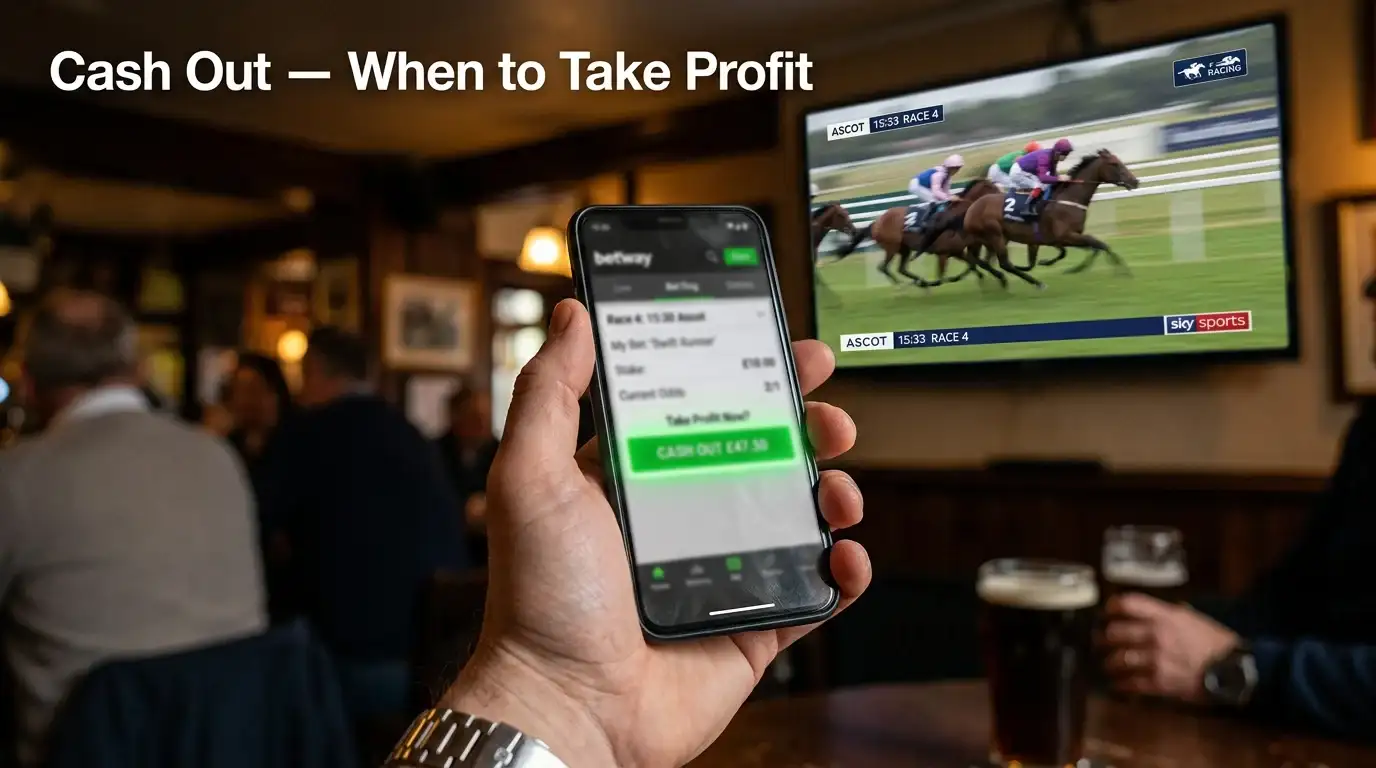
Settling a Bet Before the Finish Line
Cash out gives you the power to settle a bet before the race finishes — locking in a profit when your horse is travelling well, or cutting a loss when the situation deteriorates. It sounds like the perfect tool: complete control over the outcome before the finish line. But the bookmaker does not offer cash out from generosity. Every cash-out price has a margin built in, and that margin means you are always accepting less than the mathematical fair value of your position. Cash Out Horse Racing Bets — More on this topic at online horse betting sites.
Understanding when the margin is worth paying — and when it is better to let the bet ride — is the difference between using cash out as a strategic instrument and using it as an emotional crutch. Horse racing generates £766.7 million in gross gambling yield from remote betting annually, and cash-out margin is a meaningful contributor to that figure. The bookmaker profits every time you press the button. Your job is to ensure you profit too.
How Cash Out Works on Racing
Cash out recalculates the value of your bet in real time based on the current state of the market. If you backed a horse at 8/1 and the market now prices it at 3/1, your bet has become more valuable — the horse’s chances have improved since you placed the wager. The bookmaker offers you a cash-out figure that reflects this improved position, minus their margin.
Three forms of cash out are available at most major bookmakers. Full cash out settles the entire bet at the offered price. Partial cash out lets you take a portion of the value while leaving the rest of the bet active — effectively splitting your exposure between a guaranteed return and an ongoing position. Auto cash out allows you to set a threshold: if the cash-out value reaches a specified amount, the system settles automatically without requiring you to be watching.
The timing of cash-out availability differs between ante-post and day-of-race markets. Ante-post bets may offer cash out weeks before the race as market prices fluctuate. Day-of-race cash out begins when the market opens and continues through to the in-play phase, though availability can be suspended during the race itself — particularly during critical moments like approaching the final fence in a jumps race, when prices shift too rapidly for the bookmaker to maintain a stable offer.
The in-play cash-out calculation moves fast. A horse leading by ten lengths at the second-last might generate a cash-out offer close to the full potential return. The same horse stumbling at the last could see the cash-out value collapse to near zero in seconds. The speed at which racing unfolds makes in-play cash out on horse racing fundamentally different from football, where the pace of change is slower and the decision window wider.
When to Cash Out — and When Not To
Cash out makes strategic sense in specific circumstances. The first is when you have a significant paper profit and the remaining risk is meaningful. If you backed a horse at 10/1 in a five-horse race and it is trading at 2/1 with one fence to go, cashing out secures a substantial return while the risk of a fall, an error, or a late challenge remains real. The expected value of cashing out versus letting it ride depends on your assessment of the remaining risk — but when the profit is large relative to your stake and the race is not over, taking money off the table is a legitimate decision.
The second scenario is accumulator cash out. When three legs of a four-fold have won and the final leg is about to run, the cash-out value reflects the near-complete success of the bet. If the final leg is a marginal selection — one you are less confident about than the first three — cashing out before the last race secures most of the multi-fold return without risking the entire bet on the weakest link.
Cash out does not make sense when the margin the bookmaker is charging exceeds the risk you are trying to avoid. On a single bet with a horse priced at even money, the cash-out offer will always be below the potential return by enough to make holding more profitable in expected-value terms. The HBLB Annual Report notes that average turnover per race has dropped 19% over three years — a trend partly linked to more cautious staking behaviour. Cash out feeds into this pattern: punters who cash out habitually reduce their average returns, effectively paying the bookmaker a premium for perceived certainty.
Which Bookmakers Offer the Best Cash Out
Bet365 is widely considered the benchmark for cash-out functionality on horse racing. Full, partial, and auto cash out are all available, and the speed of execution is consistently fast even during live racing. The cash-out button is prominently placed within the bet slip, and the offered value updates in real time as odds change.
Paddy Power offers full and partial cash out with a clean interface that makes the value easy to understand before you commit. The app handles in-play cash out on racing well, though suspension during critical moments is common — as it is across all operators. Paddy Power’s “edit my acca” feature, which allows you to swap selections rather than simply cashing out, adds a dimension that other bookmakers do not offer in the same way.
William Hill provides full and partial cash out on most racing markets. The post-888 platform has improved responsiveness, and the cash-out value is displayed alongside the potential full return, making the comparison intuitive. Coral and Ladbrokes, sharing the Entain platform, offer similar cash-out functionality with reliable execution speed and clear in-app display of offered values.
Betfair Sportsbook offers cash out on its fixed-odds racing bets, while the Exchange provides the equivalent through trading — backing and laying to lock in a profit without a formal cash-out button. The Exchange approach avoids the bookmaker’s cash-out margin entirely, though it requires active management and a counterparty willing to take the other side of your trade.
Cash Out Pitfalls
The most common cash-out mistake is overuse. Punters who cash out on every bet that moves into profit are systematically selling their winning positions at a discount. Over hundreds of bets, the cumulative cost of the cash-out margin adds up to a meaningful reduction in long-term returns. Cash out should be a selective tool, not a default response to seeing green numbers on screen.
Emotional cashing out is the second trap. The urge to lock in profit intensifies as the cash-out value rises — a psychological effect that has nothing to do with rational assessment of the remaining risk. If your horse is travelling well with two furlongs to run and the form analysis that led you to back it still holds, the case for letting the bet ride is strong. Cashing out because the number on screen makes you nervous is paying the bookmaker to manage your emotions. See also Ante-Post Betting on Horses.
As Fiona Palmer, CEO of GAMSTOP, has emphasised, working to destigmatise tools like self-exclusion and increase awareness among younger consumers is an accelerating priority. In the cash-out context, habitual overuse can be an early warning sign of broader gambling control issues. If you find yourself cashing out not because the strategic logic demands it, but because you cannot tolerate the uncertainty of waiting for a result, that pattern is worth examining honestly. Control the outcome before the finish line — but make sure the control is strategic, not compulsive.
