
 Available in US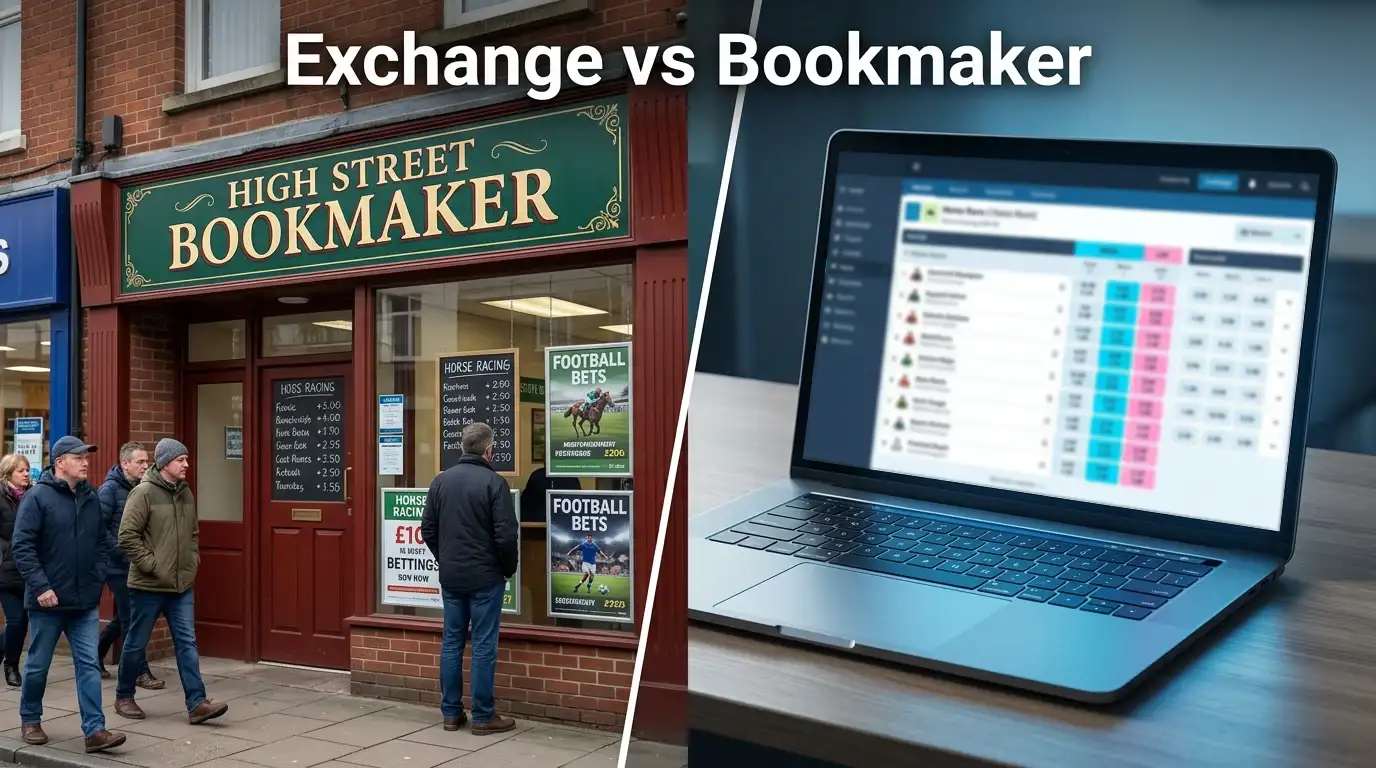
What Most Punters Never Try
The majority of horse racing punters in Britain have never placed a bet on an exchange. They stick with traditional bookmakers — Bet365, Coral, William Hill — and never question whether the odds they receive are the best available. In doing so, they consistently pay a hidden cost: the bookmaker’s margin, baked into every price on every race. On an exchange, that margin effectively disappears, replaced by a small commission on winning bets that is almost always lower than the bookmaker’s built-in edge. Betting Exchange vs Bookmaker — More on this topic at online horse betting sites.
The remote casino, betting, and bingo sector generates £7.8 billion in gross gambling yield annually across the UK. Exchanges account for a fraction of that figure, yet they consistently offer superior odds on liquid markets. The market, not the house — that is the fundamental difference, and understanding it changes how you think about every bet you place.
How a Betting Exchange Works
A betting exchange is a peer-to-peer platform. Instead of betting against a bookmaker, you bet against other punters. Every bet requires two sides: a backer, who believes a horse will win, and a layer, who believes it will not. The exchange matches these opposing positions and takes a commission from the winner.
Backing works exactly like a traditional bet. You select a horse, choose your stake, and if it wins, you collect your returns minus commission. Laying is the opposite: you are effectively acting as the bookmaker, offering odds to someone else. If the horse loses, you keep their stake (minus commission). If it wins, you pay out at the agreed odds. This two-sided market is what creates the exchange’s pricing advantage — the odds are set by supply and demand, not by a bookmaker’s risk management team.
Unmatched bets are a reality on exchanges. If you request odds of 8/1 but no one is willing to lay at that price, your bet sits in the queue until a counterparty arrives — or expires unfulfilled. On high-profile races, liquidity is deep and bets are matched instantly. On a Tuesday afternoon at a minor track, you may find thin markets where getting matched at your desired price requires patience or compromise.
Commission structures vary by exchange. Betfair offers three packages through its My Betfair Rewards programme: Rewards+ at 8%, Rewards at 5%, and Basic at 2% — each with different supplementary benefits. The default Rewards package charges 5% on net winnings, while the Basic package at 2% suits punters focused purely on the lowest commission rate. Smarkets operates at a flat 2% commission. Betdaq typically charges 2-3%. The commission is deducted only from winnings, not from stakes — if you lose, you pay nothing beyond your stake.
Margin Comparison: Exchange vs Bookmaker
The overround is the measure of a bookmaker’s margin. It represents the percentage above 100% that the sum of implied probabilities across all runners reaches. A perfectly fair market would total exactly 100%. In practice, bookmakers typically operate at 110-120% on horse racing — meaning the punter is paying 10-20% above fair value, distributed across all the prices in the market.
On an exchange, the equivalent figure — the market percentage — is dramatically lower. A liquid horse racing market on Betfair might trade at 101-103%. Even after the 5% commission on winnings, the effective cost to the punter is significantly less than the bookmaker’s margin. The mathematics are unambiguous: on identical selections at identical probabilities, the exchange delivers a better return.
Here is a concrete example. A six-runner race at a traditional bookmaker might price the field as follows: 5/2, 7/2, 9/2, 6/1, 10/1, 14/1. Converting to implied probabilities: 28.6% + 22.2% + 18.2% + 14.3% + 9.1% + 6.7% = 99.1%. But that represents the raw probabilities; the actual market sums to higher because bookmakers express odds that embed their margin. In practice, the same bookmaker would offer these prices as 2/1, 3/1, 4/1, 5/1, 8/1, 12/1 — tighter prices that sum to 25% + 20% + 16.7% + 14.3% + 11.1% + 7.7% = 114.8%. That 14.8% above 100% is the overround — the bookmaker’s built-in edge. On the exchange, the same race might show back prices of 3.6, 4.6, 5.6, 7.2, 11.0, 15.0 in decimal odds — summing to approximately 101.5%.
The difference is stark. A £10 win bet on the 4/1 horse at the bookmaker returns £50. On the exchange at 5.6 (23/5), the same horse returns £56 before commission. After 5% commission on the £46 profit, you receive £53.70 net — still more than the bookmaker’s payout. The real advantage compounds over volume: across hundreds of bets, the exchange’s narrower margin translates into meaningfully higher returns. According to the HBLB Annual Report, average turnover per race has fallen 19% over three years, partly reflecting how affordability checks have suppressed large-staking activity — but on the exchange, this liquidity squeeze hits harder on minor meetings where fewer punters participate.
When Bookmakers Win
Exchanges are not superior in every situation. Traditional bookmakers retain distinct advantages that make them the better choice under specific circumstances, and pretending otherwise would be dishonest analysis.
Best Odds Guaranteed is the most significant bookmaker advantage. BOG does not exist on exchanges. If you take 5/1 on the exchange and the SP drifts to 8/1, you receive 5/1 — end of story. With a bookmaker offering BOG, you would be upgraded to 8/1 automatically. For punters who bet early in the day and benefit from price drift, this single feature can outweigh the margin advantage of the exchange.
Free bets and promotional offers are bookmaker territory. Welcome bonuses, acca insurance, money-back specials, enhanced odds — none of these exist on exchanges. For recreational punters who bet occasionally and want to maximise the value of sign-up promotions, bookmakers offer tangible financial incentives that exchanges cannot match.
Simplicity is another factor. Bookmaker apps present a single price; you take it or leave it. Exchange apps require understanding of back, lay, matched and unmatched bets, and commission calculations. The learning curve is not steep, but it exists, and for punters who bet for entertainment rather than profit optimisation, the bookmaker’s streamlined experience is genuinely preferable.
Liquidity issues on minor races also favour bookmakers. A bookmaker will quote a price on every declared runner in every race. The exchange may show thin markets on minor meetings, meaning your bet may not get matched, or the available prices may be worse than the bookmaker’s quote. For punters who bet across the full spectrum of daily racing — not just feature events — the bookmaker provides guaranteed access to a price.
Exchange Strategies for Racing
For punters who move beyond simple backing, the exchange opens strategic possibilities that bookmakers cannot replicate.
Laying the favourite is the simplest exchange strategy. In horse racing, favourites win roughly 30-35% of the time, meaning they lose 65-70% of the time. Laying a favourite at short odds — say 2/1 — means you profit whenever any of the other runners wins. The risk is defined: if the favourite wins, you pay out at the agreed odds. The reward is the layer’s stake, collected two-thirds of the time in a fair market. This strategy is not a guaranteed winner — commission, odds accuracy, and selection quality all matter — but it is a legitimate approach that is impossible with a traditional bookmaker.
Pre-race trading involves backing a horse at one price and laying it at a shorter price as the market moves. If you back at 6.0 and the price shortens to 4.0 before the race, you can lay at 4.0 to lock in a profit regardless of the result. This is called “greening up” — creating a position where you win the same amount whether the horse wins or loses. It requires the price to move in your favour, which means it rewards punters who have a genuine edge in predicting market direction. See also Cheltenham Festival Betting Guide 2026.
In-running trading takes this further, using live price movements during the race itself. Prices on the exchange shift dramatically as the race unfolds — a horse leading at the second-last fence will see its price collapse, while a horse struggling to keep up drifts rapidly. Experienced traders back at long prices during the race and lay at short prices when the horse hits the front. The margins are compressed and the speed of execution is critical, but the potential returns are substantial for those with the skill and nerve to operate in real time. The market, not the house — and on the exchange, the market moves in real time with every stride.
