
 Available in US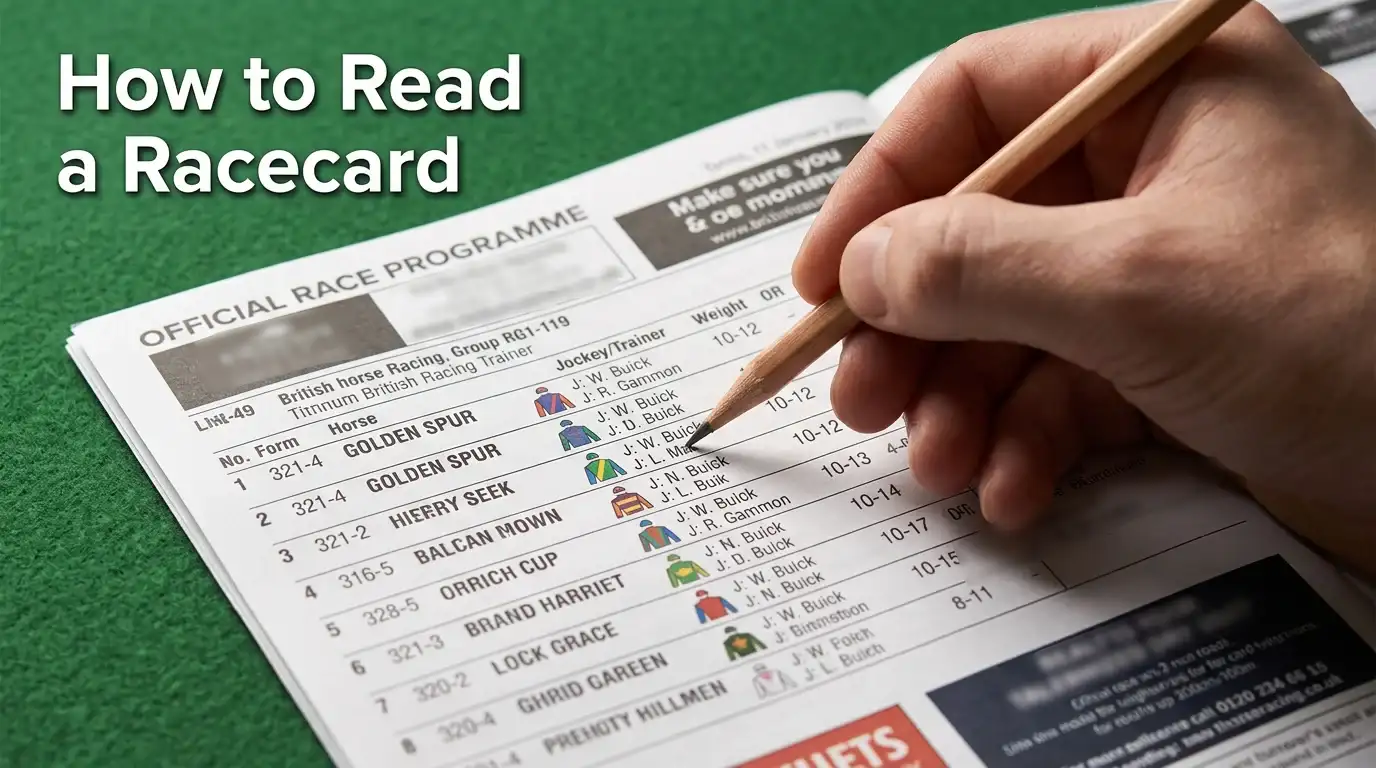
Your Briefing Document Before Every Race
The racecard is your briefing document before every horse race. It compresses fifteen or more variables per runner into a single compact display — and knowing how to read it is what separates an informed bet from a coin flip. Every bookmaker app, every racing newspaper, and every course programme presents some version of a racecard, yet the format intimidates newcomers with its density of abbreviations, numbers, and symbols. How to Read a Horse Racing Racecard — More on this topic at online horse betting sites.
That intimidation is unnecessary. The racecard follows a logical structure, and once you learn what each element means, you can assess a horse in under a minute. With 5.031 million people attending British racecourses in 2025 — the highest figure since 2019 — and millions more betting online, the racecard is relevant whether you are standing in the parade ring or sitting on your sofa with a phone in your hand.
This guide walks through the racecard element by element, explains form figures in plain language, identifies which numbers deserve the most attention, and finishes with a worked example that ties everything together. Decode before you bet — the card has already done most of the work for you.
Anatomy of a Racecard
Every racecard, whether printed or digital, organises information into a set of standard fields. As Gambling Commission CEO Andrew Rhodes has noted, a data-driven understanding of gambling is essential for all stakeholders — and for horse racing punters, the racecard is where that data begins. Here is what you will find, working from left to right across a typical layout.
The cloth number appears first. This is the number displayed on the horse’s saddlecloth during the race, making it easy to identify runners on screen or at the track. In flat races, the draw number appears alongside it — the stall position the horse will start from. Draw is significant at certain courses: a low draw at Chester, for example, offers a genuine advantage on the tight bends, while at straight-course tracks like Ascot over five furlongs, stall position has less impact.
Next comes the horse’s name, often accompanied by symbols that indicate sex and age. A five-year-old gelding might appear as “5 g” after the name. The age matters because it determines weight-for-age allowances and eligibility for certain races. Juvenile races are restricted to two-year-olds; Classic races to three-year-olds. National Hunt horses tend to be older, typically five and upward for the major chases.
The form figures follow — a string of numbers and letters that we will decode in the next section. After form, you will see the horse’s weight, expressed in stones and pounds. In handicap races, the official handicapper assigns this weight based on the horse’s rating. In non-handicap races, weight is determined by age and sex allowances.
The jockey and trainer are listed next. Both are critical. A top trainer with a 25% strike rate at a particular course sends a different signal than a handler with 5% at the same venue. Jockey bookings can also move the market — when a leading rider picks up a spare ride, it often indicates stable confidence.
Headgear is noted with single-letter codes. A “b” means blinkers, which restrict rear vision and help horses that are easily distracted. A “t” is a tongue tie, used to prevent the horse’s tongue from obstructing its airway. A “v” denotes a visor, a milder form of blinkers. A “p” is cheekpieces. A “h” marks a hood, worn in the paddock and removed before the start. First-time headgear is often flagged with a superscript “1” and is considered a significant form indicator — trainers typically apply equipment changes for a reason.
The official rating (OR) is the BHA handicapper’s assessment of the horse’s ability on a numerical scale. Higher is better. Speed ratings such as RPR (Racing Post Rating) or Topspeed offer alternative assessments based on race times and track conditions. Days since last run tells you how fresh or race-fit the horse is. All of these numbers combine into a picture that, once you can read it, reveals far more than the odds alone.
Reading Form Figures
Form figures are the racecard’s shorthand for recent results, and they read from left to right in chronological order — oldest run first, most recent run last. A horse showing 112-34 finished first, first, second in its previous season (before the dash), then third and fourth in its current campaign. The dash separates seasons: everything to its left is from the previous year or earlier.
The numbers represent finishing positions: 1 means first, 2 means second, and so on up to 9. A zero (0) means the horse finished tenth or worse — essentially unplaced by any measure. The letter F indicates a fall, which is particularly relevant in National Hunt racing where jumping errors are part of the game. U means the jockey was unseated, P means the horse was pulled up (the jockey decided to stop before the finish, often because the horse was tailing off or was not travelling well), and R means the horse refused at a fence or hurdle.
Two letters carry special positive weight. C means the horse has won at this course before, and D means it has won over this distance. When you see CD next to a horse’s name, it has proven ability at both the venue and the trip — a combination that serious form students pay close attention to. These indicators do not guarantee a repeat performance, but they remove uncertainty about whether the horse handles the specific conditions of today’s race.
A slash (/) in the form line indicates a longer break, typically a year or more between runs. A horse showing 11/2-0 won twice over a year ago, finished second after returning, and then ran poorly last time. The gap raises questions: was the absence due to injury, and has the horse returned at the same level?
The key to reading form is context, not just position numbers. A horse that finished third in a Group 1 at Ascot was running against far better opposition than a horse that won a Class 6 seller at a minor track. The form figure shows the result; you need the race class and competition level to interpret what that result actually means.
The Numbers That Matter Most
Not every number on the racecard carries equal weight. For different types of races, different metrics take priority, and knowing where to focus saves time and improves decision quality.
The Official Rating is the starting point for handicap races. It tells you how the BHA handicapper ranks this horse against the rest of the field. A horse rated 95 carrying 9st 7lb in a 0-100 handicap is near the top of the range, which means it faces a weight burden but is theoretically the most talented runner. A horse rated 80 in the same race carries less weight but may be outclassed. The most useful insight comes from comparing the OR with independent speed figures — a discrepancy can signal opportunity.
Speed ratings — RPR and Topspeed being the most widely referenced — offer a different lens. While the OR reflects the handicapper’s opinion, speed figures are calculated from actual race times adjusted for track conditions. A horse that clocked an RPR of 140 last time is more objectively proven than one rated 140 by the handicapper based on a visual assessment of its margin of victory. In non-handicap races, where there is no OR-based weight assignment, speed ratings become the primary comparative tool.
With 21,728 horses in training across Britain in 2025, the trainer’s strike rate matters as a filtering mechanism. A 20% strike rate at today’s course tells you one in five runners the trainer sends there wins. Combine that with a jockey who also has strong course form, and you have a meaningful statistical edge before you even look at the horse’s individual profile.
Days since last run is undervalued by casual punters. Horses returning after a long layoff (60+ days) may need the run to regain fitness. Conversely, horses running within seven to fourteen days of a good effort are often in peak form, and trainers who bring horses back quickly after a win are frequently targeting a specific opportunity. In National Hunt racing, freshness matters differently — jumps horses often improve for a break, particularly young novices stepping up in trip.
Putting It Together: A Worked Example
Let us apply everything above to a single runner. Imagine the following racecard entry for a Class 3 handicap hurdle over two miles and four furlongs at Cheltenham, good to soft ground.
Cloth 7 — Harbour Rock (IRE), 6 g. Form: 21F1-2. OR 132. RPR 138. Weight: 11st 2lb. Jockey: Nico de Boinville. Trainer: Nicky Henderson (Cheltenham strike rate 22%). Days since last run: 18. Headgear: none. CD.
Start with the form. The sequence 21F1-2 tells you this horse was second, then won, then fell, then won again last season — and finished second on his first run of the current campaign. The fall is a concern in any jumps race, but the two wins and two places from five starts show a horse that is competitive more often than not. The current-season second suggests he returned in decent shape.
The CD flag means he has won at Cheltenham over this distance. That is a strong positive on a track with pronounced undulations and a demanding uphill finish that catches out horses without the required stamina. His OR of 132 against an RPR of 138 suggests the speed figures consider him better than the handicapper does — a potential sign he is well-handicapped.
Nicky Henderson at a 22% Cheltenham strike rate is one of the best trainer-course combinations in jumps racing. The jockey booking confirms stable confidence. Eighteen days since last run is a comfortable gap — fresh enough to be race-fit, not so long as to raise fitness doubts.
Ground is good to soft, which suits a horse with Irish form (the IRE suffix) where softer conditions are standard. No headgear suggests the trainer is satisfied with the horse’s focus and does not need equipment corrections. See also Horse Racing Form Guide.
Verdict: this is a horse ticking multiple boxes — course-and-distance form, a top trainer-jockey combination, a rating that may understate his ability, and suitable ground conditions. He warrants serious consideration, and the racecard alone has provided every piece of evidence needed to reach that conclusion. Decode before you bet — and the card does most of the thinking for you.
