
 Available in US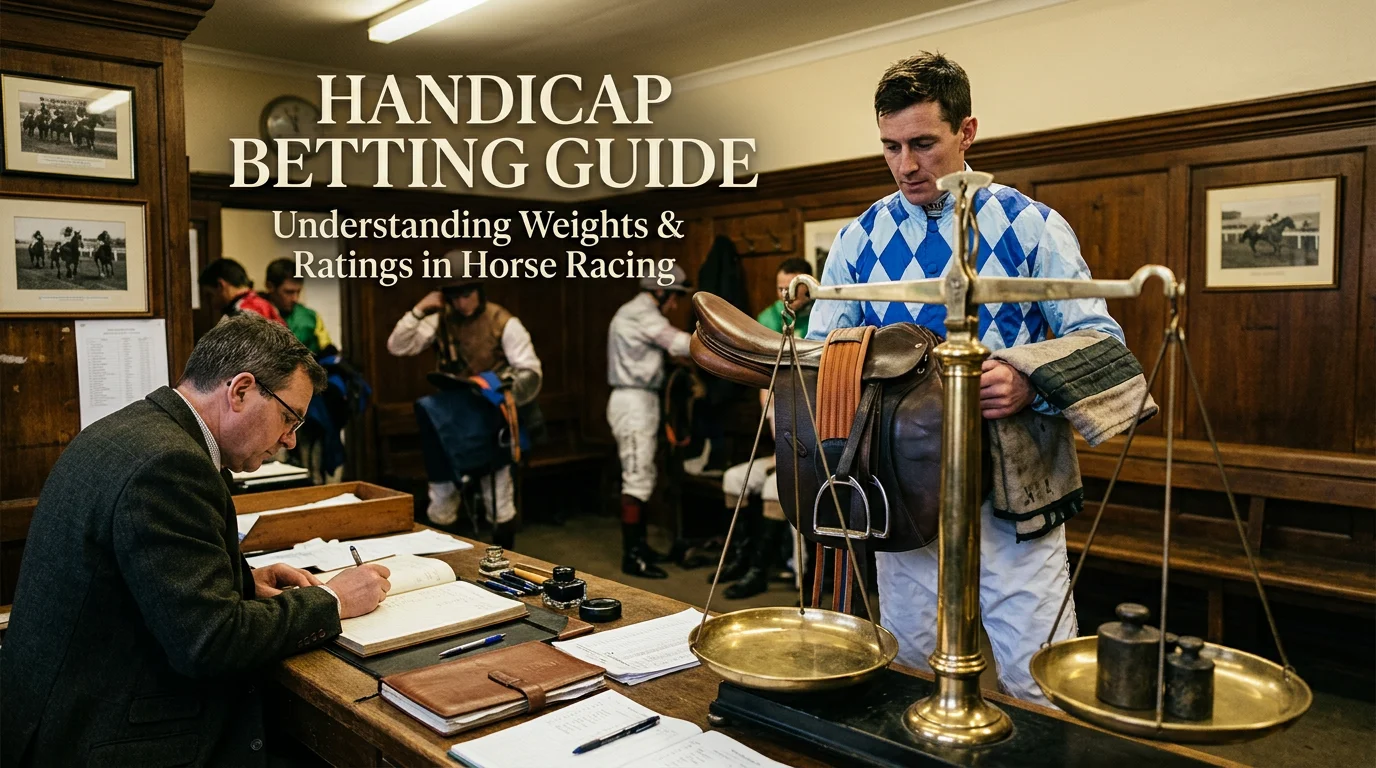
The Backbone of British Racing
Handicap races make up more than 60% of the racing programme in Britain. They are the bread and butter of UK betting — large fields, competitive finishes, and a weight-based equalisation system designed to give every runner a theoretical chance of winning. The BHA handicapper assigns each horse a weight based on its assessed ability, expressed through an official rating. The better the horse, the more weight it carries. The idea is that in a perfectly handicapped race, every horse crosses the line at the same time. Horse Racing Handicap Betting — More on this topic at online horse betting sites.
Of course, perfection is theoretical. Handicappers are skilled but not omniscient, and the gaps between their assessments and a horse’s true ability are where the value lives for punters. With total prize money reaching £153 million in 2025 — a significant portion allocated to handicap races — the incentive for trainers to exploit these gaps is substantial. Where the handicapper is the real opponent, understanding the system is the first step to finding edges within it.
How the Handicap System Works
Every horse that has run three or more times on a racecourse receives an official rating from the BHA handicapper. This rating, expressed on a numerical scale from 0 to 175 (with higher being better), represents the handicapper’s assessment of the horse’s ability relative to every other rated horse in Britain. A horse rated 100 is considered significantly more talented than one rated 70, but in a handicap race, that difference is translated into a weight differential designed to equalise their chances.
The weight allocation works on the principle that one pound of weight corresponds to approximately one length over a mile. A horse rated 100 in a 0-100 handicap carries top weight — typically 10 stone or higher. A horse rated 70 carries correspondingly less, sometimes 30 pounds lighter. The weight range creates the competitive balance that makes handicap racing unpredictable and attractive to bettors.
After every run, the handicapper reassesses. A horse that wins impressively will see its rating raised — often by several pounds — making its next handicap assignment tougher. A horse that runs poorly may be dropped in the ratings, receiving less weight next time and theoretically becoming more competitive. This dynamic adjustment means handicap marks are never static: they respond to performance, and the best trainers manage their horses’ marks strategically, sometimes deliberately targeting moderate performances before a big handicap to keep the rating low.
With 21,728 horses in training across Britain, the handicapper’s task is enormous. Every raceday produces data that feeds into rating adjustments, and the system processes thousands of performances per week to maintain an up-to-date picture of the entire horse population. The scale of this operation means that some horses inevitably slip through the net — rated below their true ability — and identifying those horses is the core skill of handicap betting.
Finding the Well-Handicapped Horse
A well-handicapped horse is one whose ability exceeds its official rating — meaning it carries less weight than its true talent warrants. These horses are the Holy Grail for handicap punters, because they have a structural advantage that the handicapper has not yet corrected.
The most common source of well-handicapped runners is the lightly raced horse. A horse with only four or five career starts has a limited data set for the handicapper to work with. If its best performance came in conditions that did not fully showcase its ability — soft ground when it prefers firm, a distance that was too short, a race run at a slow pace — the handicapper may have assessed it conservatively. When conditions align properly, the horse can outperform its mark significantly.
Horses that have been off the track for an extended period and return in a handicap represent another opportunity. The handicapper cannot adjust a rating based on private work at home, so a horse that has improved during a break — through maturity, treatment of a minor physical issue, or a change of training method — may return to racing ahead of its mark. Trainers who bring horses back from breaks with strong first-up records are worth tracking.
Code-switchers provide a less obvious angle. A horse dropping from flat to jumps, or stepping up from hurdles to fences, enters a new context where its existing rating may not reflect its aptitude for the new discipline. A flat horse with strong stamina form can dominate at the lower levels of National Hunt racing off a modest hurdle mark, because the handicapper bases the initial assessment on limited jumping form rather than the horse’s proven flat ability.
Big-Field Handicap Strategy
Big-field handicaps — races with sixteen or more runners — are the natural home for each-way punters. The standard terms offer four places at one-quarter the odds, and bookmakers frequently enhance this to five or six places during major meetings. In a twenty-runner handicap, the probability of your horse finishing in the first four or five is materially higher than the bookmaker’s margin typically accounts for, particularly when the field is competitive and no single horse dominates the market.
Draw bias is a critical factor in certain big-field handicaps, particularly on the flat. At courses with a straight track — Ascot over five and six furlongs, York over similar distances — the stall position can confer a measurable advantage depending on ground conditions. A high draw on soft ground at Ascot has historically outperformed low draws, because the softer ground tends to ride slower near the rail. Checking draw statistics by course, distance, and going before any big-field handicap selection is essential analysis that many punters neglect.
Pace analysis matters in large fields. A race with several front-runners is likely to be run at a strong pace, which benefits hold-up horses who can conserve energy and finish strongly. A race with no obvious pace can develop into a tactical affair where early position is crucial. Assessing the likely pace scenario, based on the running styles of the declared field, adds a dimension to handicap analysis that goes beyond individual horse form.
The Heritage Handicaps
Britain’s heritage handicaps are the flagship betting races of the flat season — big-field, high-value events that attract the most competitive handicap fields of the year and generate some of the largest betting volumes outside the Cheltenham Festival.
The Lincoln, run at Doncaster in late March or early April, traditionally opens the flat turf season. It attracts a maximum field of twenty-two runners over a mile, and the ante-post market is one of the most active of the spring. The Cambridgeshire, run at Newmarket in late September over nine furlongs, is another historic betting race with similarly large fields and deep ante-post interest.
The Cesarewitch, also at Newmarket, is run over two miles and two furlongs in October — the longest major flat handicap in Britain. Its unusual distance attracts a different type of horse, often including some with National Hunt connections, and the form puzzle is more complex than shorter handicaps. The Ebor at York, the Stewards’ Cup at Goodwood, and the Wokingham at Ascot round out the major heritage handicaps, each with its own character, field size, and betting dynamics. See also Virtual Horse Racing Betting.
These races are where handicap betting reaches its highest expression: large fields, competitive weights, deep form analysis required, and substantial each-way value available. Where the handicapper is the real opponent — and in the heritage handicaps, the opponent is working at full stretch.
