
 Available in US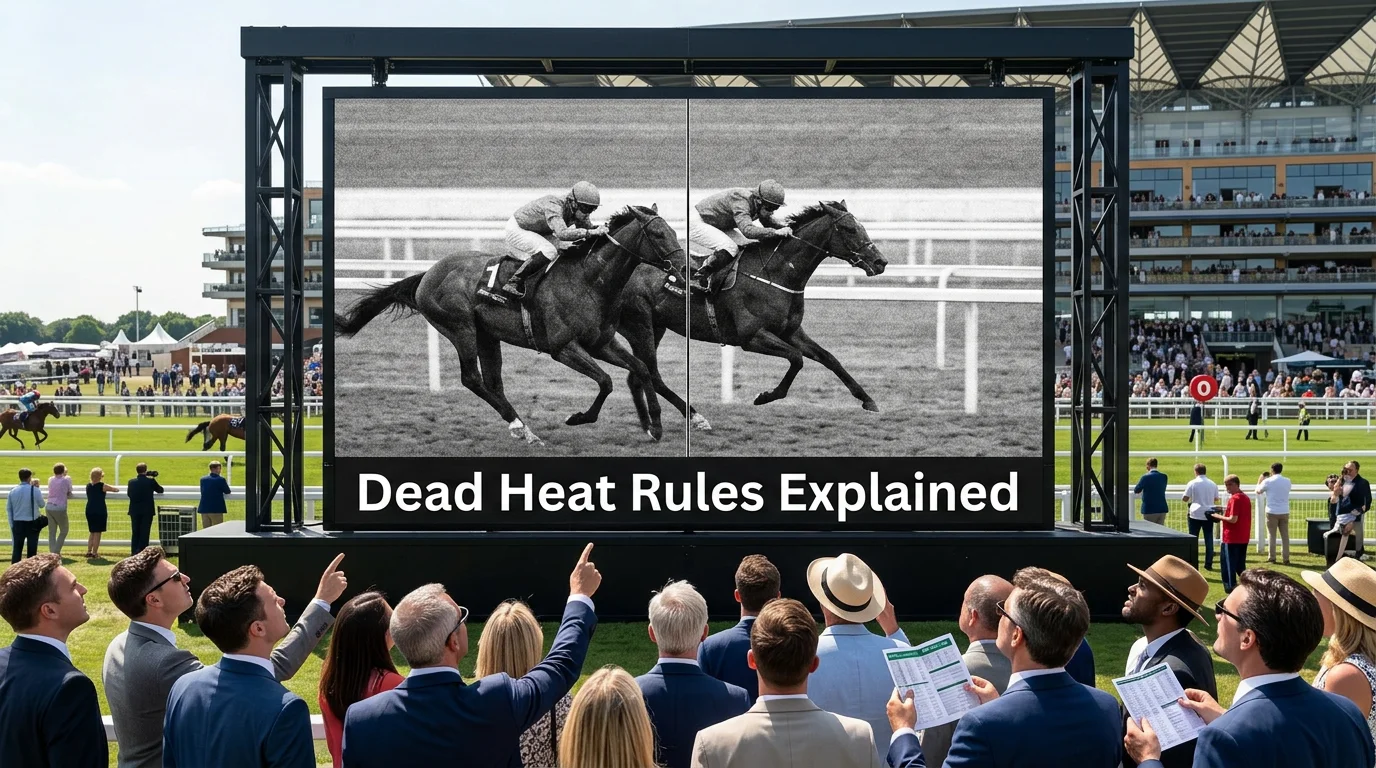
Rare, But Not Unusual
Dead heats are rare in modern horse racing, but they are not unusual — and the payout rules that apply when two or more horses cannot be separated at the finish catch punters off guard every time they occur. The settlement process is not intuitive: your stake is effectively divided, paid at full odds on the reduced portion, and the difference between what you expected and what you receive can feel like a loss even when your horse technically won. Dead Heat Rules in Horse Racing Betting — More on this topic at online horse betting sites.
Understanding the dead heat rule before it applies to your bet is the only way to avoid that unpleasant surprise. With 5.031 million people attending British racecourses in 2025, dead heats happen in front of crowds, on television, and across millions of active betting slips — and the maths that determines your payout is the same whether you are watching from the grandstand or the sofa. When the line cannot separate them, the numbers have to.
The Dead Heat Rule Explained
The dead heat rule applies whenever two or more horses are declared inseparable for a finishing position. The principle is straightforward: your stake is divided by the number of horses involved in the dead heat, and each portion is paid at full odds.
Here is a two-way dead heat for first place. You have a £10 win bet on Horse A at 6/1. Horse A and Horse B cross the line together and the judge declares a dead heat. Your £10 stake is halved to £5. That £5 is paid at the full 6/1 odds: £5 multiplied by 6 = £30 profit, plus your £5 stake returned. Total return: £35. Without the dead heat, you would have received £70 (£60 profit plus £10 stake). The dead heat has cost you exactly half your potential payout.
A three-way dead heat divides the stake by three. The same £10 bet at 6/1 becomes a £3.33 effective stake, paid at 6/1: £20 profit plus £3.33 stake = £23.33 total return. Three-way dead heats are extremely rare but the rule applies identically.
The critical point is that the odds do not change — only the stake is reduced. You are paid the full quoted price on a fraction of your money. This is the industry standard across all UKGC-licensed bookmakers, and it applies automatically at settlement. There is no discretion, no negotiation, and no alternative calculation. The rule is the rule.
Dead heats can also occur for places, not just the win. If two horses tie for third place in a race paying three places each-way, the dead heat rule applies to the place portion of any each-way bets on those horses. This is where the mathematics become more complex and less expected — a dead heat for a place position can reduce the return on a bet where the punter assumed the place part was safe.
Dead Heats in Each-Way Bets
Each-way dead heats require separate calculations for the win and place parts of the bet. Consider a scenario where you place £10 each-way (£20 total) on Horse A at 8/1 in an eight-runner non-handicap. Place terms are 1/5 the odds for three places. Horse A dead-heats for first with Horse B.
The win part: your £10 win stake is halved to £5. Paid at 8/1: £5 multiplied by 8 = £40, plus £5 stake = £45 win return. The place part: Horse A has placed (it finished joint-first, which counts as a placing). The place portion is not affected by the dead heat for first because the dead heat only applies to the position that is tied. Your full £10 place stake is paid at 1/5 of 8/1 = 8/5: £10 multiplied by 1.6 = £16, plus £10 stake = £26. Total return: £45 plus £26 = £71 on a £20 outlay.
Now consider a dead heat for third place in the same race, where your horse finishes in the dead heat. The win part loses completely — your horse did not win. The place part is where the dead heat rule kicks in: your £10 place stake is halved to £5, paid at 8/5: £5 multiplied by 1.6 = £8, plus £5 stake = £13. Total return: £13 on a £20 outlay. You have lost £7 despite your horse officially placing.
This second scenario is the one that surprises punters most. A place dead heat can turn a positive each-way result into a net loss, because the reduced place return does not cover the lost win stake plus the reduced place stake. Knowing this in advance does not prevent the dead heat, but it does prevent the frustration of discovering the maths at settlement.
Dead Heats in Multiples
Dead heats in accumulators and other multiples compound their impact across legs. When one leg of an accumulator results in a dead heat, the dead heat rule is applied to that leg, and the reduced return rolls forward as the stake for the next leg.
Example: a treble with legs at 3/1, 4/1, and 5/1, stake £5. Without any dead heat, the return is £5 at 3/1 = £20, then £20 at 4/1 = £100, then £100 at 5/1 = £600. Total return: £600. Now suppose the first leg results in a two-way dead heat. The £5 stake is halved to £2.50, paid at 3/1: £2.50 multiplied by 3 = £7.50, plus £2.50 = £10. That £10 becomes the stake for leg two: £10 at 4/1 = £50. Then £50 at 5/1 = £300. Total return: £300 — exactly half the non-dead-heat outcome.
In full-cover bets like a Lucky 15 or a Yankee, the dead heat affects every combination that includes the dead-heated selection. The reduction cascades through doubles, trebles, and the four-fold, with each combination recalculated using the halved stake for the affected leg. The impact is proportional but can be significant when the dead-heated leg carried long odds that were multiplying through the combinations.
How Often Do Dead Heats Happen?
Dead heats for first place occur in approximately one in every 500 to 1,000 races in British horse racing — infrequent enough that most punters will encounter one only a handful of times per year, but common enough that being unprepared is a choice rather than an excuse.
Place dead heats are more frequent. With larger fields and tighter finishes for the minor positions, two horses crossing the line together for second or third is a regular occurrence at meetings throughout the season. The racing industry employs approximately 85,000 people across 59 licensed racecourses, and among those roles are the judges and stewards who use photo-finish technology to adjudicate close results. The technology is precise to one-thousandth of a second, and a dead heat is declared only when the equipment cannot distinguish between two images at the line.
Famous dead heats in British racing include the 2011 Cesarewitch at Newmarket, where two horses finished inseparable in one of the season’s major handicaps, and several instances in shorter sprint races where the speed of the finish compresses margins to fractions of an inch. The photo-finish system has improved over the decades, reducing the number of dead heats compared to the era when judges relied on the naked eye, but the phenomenon persists because horses genuinely do finish inseparable on rare occasions. See also Non-Runner No Bet.
The practical takeaway is simple: the dead heat rule exists, it applies automatically, and it reduces your payout in ways that are mathematically precise but emotionally unexpected. When the line cannot separate them, knowing the maths in advance is the only defence against surprise.
